Quick answer
Braces are small brackets bonded to each tooth and connected by a wire that is changed and adjusted every 6 to 10 weeks. The wire's gentle, continuous pressure moves teeth through the bone over 12 to 30 months. Metal, ceramic and self-ligating braces all work the same way; they differ in appearance, size and how the wire is held. Bonding takes about an hour and does not hurt; the following three or four days are sore. The result is held with retainers, worn on the schedule your orthodontist sets, reduced over the years but never stopped.
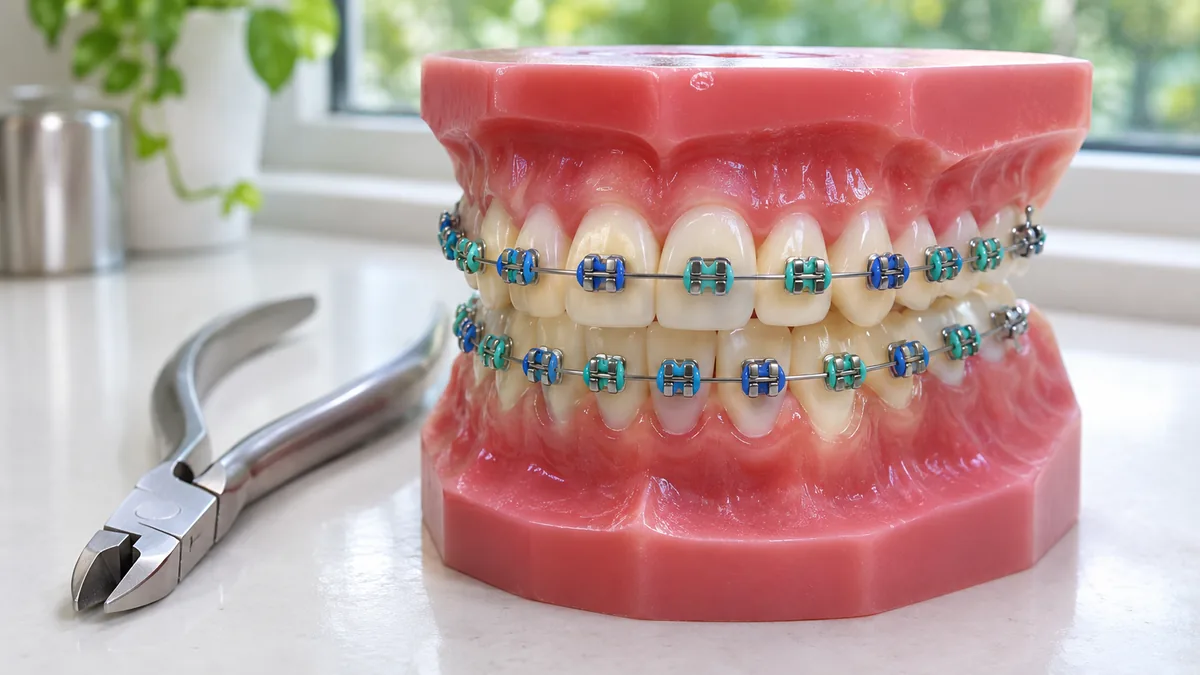
How braces move teeth
Each bracket is a handle. The wire running through the brackets is shaped to the ideal arch and, when tied in, tries to return to that shape, pulling or pushing each tooth a fraction of a millimetre at a time. Bone on the pressure side is removed by the body and bone on the tension side is laid down, so the tooth carries its socket with it. That remodelling is why movement is slow and why teeth feel loose and tender for a few days after each adjustment. For the biology in more depth, see how orthodontic treatment moves teeth.
The types of braces, and what each is like to wear
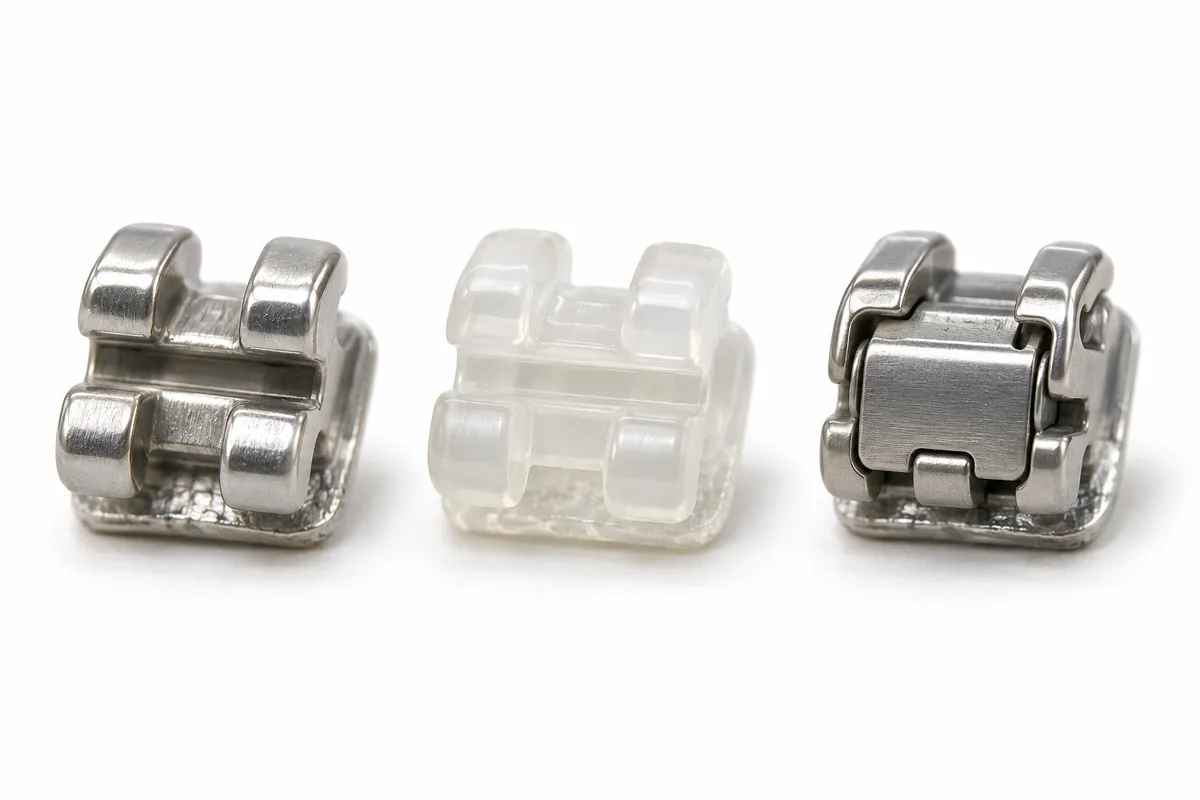
| Feature | Metal | Ceramic (clear) | Self-ligating |
|---|---|---|---|
| Appearance | Visible; colour ties change every visit | Tooth-coloured bracket; less visible at conversation distance | Metal or ceramic; no colour ties |
| Size | Smallest | Slightly larger | Similar to metal, slightly thicker |
| How the wire is held | Elastic ties (the coloured bands) | Elastic ties, clear or white; can stain | A small built-in clip |
| Staining | Ties are replaced each visit | Clear ties yellow with coffee, tea, curry and smoking between visits | No ties to stain |
| Breakage | Lowest | Brackets are more brittle; lower ceramic brackets can wear opposing teeth, so they are often used on top only | Clips can occasionally jam |
| Evidence on speed and comfort | Baseline | Same mechanics as metal | Trials have not shown a meaningful difference in treatment time or discomfort compared with conventional brackets |
| Cost | Baseline | Usually higher | Usually higher |
| Best suited to | Anyone; most teens | Adults and older teens who want discretion | Preference; no case is unsuitable for conventional brackets |
Guildford Orthodontic Centre provides metal, ceramic and self-ligating braces for suitable cases. The detailed comparison of the first two is in metal versus ceramic braces; whether to have braces at all rather than aligners is covered in braces versus Invisalign.
The treatment in five stages
- WonderWhat the assessment looks at before braces are recommended.
- CompareBraces or aligners: how the decision is really made.
- PrepareRecords, bond day, the first 24 hours and the first week.
- Live ItEating, brushing, elastics, sport, school and emergencies.
- Keep ItDebond day and the retainers that follow.
What to expect at each visit
- Records visitPhotographs, digital scan, radiographs if indicated. About 30 minutes. A written plan and quote follow at the recommended clinic.
- Bond dayBrackets bonded, first wire tied in. 60 to 90 minutes. Nothing hurts during the visit; the teeth ache afterwards. Bond day in detail.
- Adjustments (every 6 to 10 weeks)15 to 30 minutes. Ties removed, wire changed or bent, new ties chosen. Tender for one to three days. Elastics are usually introduced somewhere between month three and month nine. Elastics.
- Emergency visits (as needed)A loose bracket or long wire is a short visit, usually the same week. What to do first.
- DebondBrackets removed, glue polished off, scan for retainers. About an hour. Debond day.
- Retention checksA few visits over the following year or two to check retainers and fit. Retention.
The parts people find hardest
- The first week. Soreness peaks at day two or three; the inside of the lips toughens up within two weeks. The first week.
- Brushing. Four minutes, after meals, with attention to the gum line above each bracket. Permanent white marks are the price of skipping it. Brushing and flossing.
- Elastics. Wearing them as prescribed is the single biggest factor in how long bite correction takes.
- The last six months. The teeth look straight, the bite is still being finished, and patience runs out. Stopping early undoes the bite correction.
What braces cannot promise
No bracket system makes teeth move faster in any meaningful, evidence-supported way; the biology sets the pace. Treatment does hurt at times, though it is manageable. And the result is not permanent without retainers. Any page that tells you otherwise, including an older version of this one, was overselling.
Questions people ask
Do braces hurt?
Bonding itself does not hurt. Teeth ache for two to four days afterwards and for one to three days after each adjustment. Lips and cheeks are rubbed raw for the first week or two until they toughen. Wax and soft food handle most of it. Soreness and what helps.
How long do braces take?
Typically 12 to 30 months. Simple alignment is quickest; bite correction, extractions and impacted teeth take longest. Broken brackets and skipped elastics add months.
Can adults get braces?
Yes, at any age with healthy gums. Ceramic and metal braces are both used for adults; see adult orthodontics.
What is the difference between braces and Invisalign?
Braces are fixed and work regardless of compliance; aligners are removable and depend on 20-plus hours of wear a day. Each has movements it handles better. The full comparison.
References
- Proffit WR, Fields HW, Larson BE, Sarver DM. Contemporary Orthodontics, 6th edition. Elsevier, 2019.
- Benson PE, Parkin N, Dyer F, Millett DT, Germain P. Fluorides for preventing early tooth decay (demineralised lesions) during fixed brace treatment. Cochrane Database of Systematic Reviews 2019;(11):CD003809. https://doi.org/10.1002/14651858.CD003809.pub4
- Monk AB, Harrison JE, Worthington HV, Teague A. Pharmacological interventions for pain relief during orthodontic treatment. Cochrane Database of Systematic Reviews 2017;(11):CD003976. https://doi.org/10.1002/14651858.CD003976.pub2
- Littlewood SJ, Millett DT, Doubleday B, Bearn DR, Worthington HV. Retention procedures for stabilising tooth position after treatment with orthodontic braces. Cochrane Database of Systematic Reviews 2016;(1):CD002283. https://doi.org/10.1002/14651858.CD002283.pub4
Where Surrey families get this treatment
Guildford Orthodontic Centre
A specialist orthodontic practice in Guildford where Dr. Aly Kanani and Dr. Aida Mesbahi, both Certified Specialists in Orthodontics, provide braces, Invisalign and growth-appliance treatment for children, teens and adults.
The complimentary first visit includes an examination, photographs and a digital scan, with radiographs when indicated, and ends with a written plan and quote. Braces adjustments, aligner checks, emergency visits and retainer follow-up all happen at the same Guildford office.
- Address
- Suite 200 – 10203 152A Street, Surrey, BC V3R 4H6 (Guildford)
- Hours
- Monday to Saturday, 8 am to 5 pm
- Website
- guildfordorthodontics.com
Disclosure: SurreyBraces.com is a treatment guide published by the myORTHODONTIST network, which operates Guildford Orthodontic Centre. The guidance above applies whoever provides your care. Full disclosure.
About this guide
- Published by
- The myORTHODONTIST network
- Written by
- SurreyBraces.com editorial team
- Clinical reviewer
- Dr. Aly Kanani, Certified Specialist in Orthodontics (profile). Review assigned; sign-off date will be shown here once complete.
- First published
- 20 September 2026