Quick answer
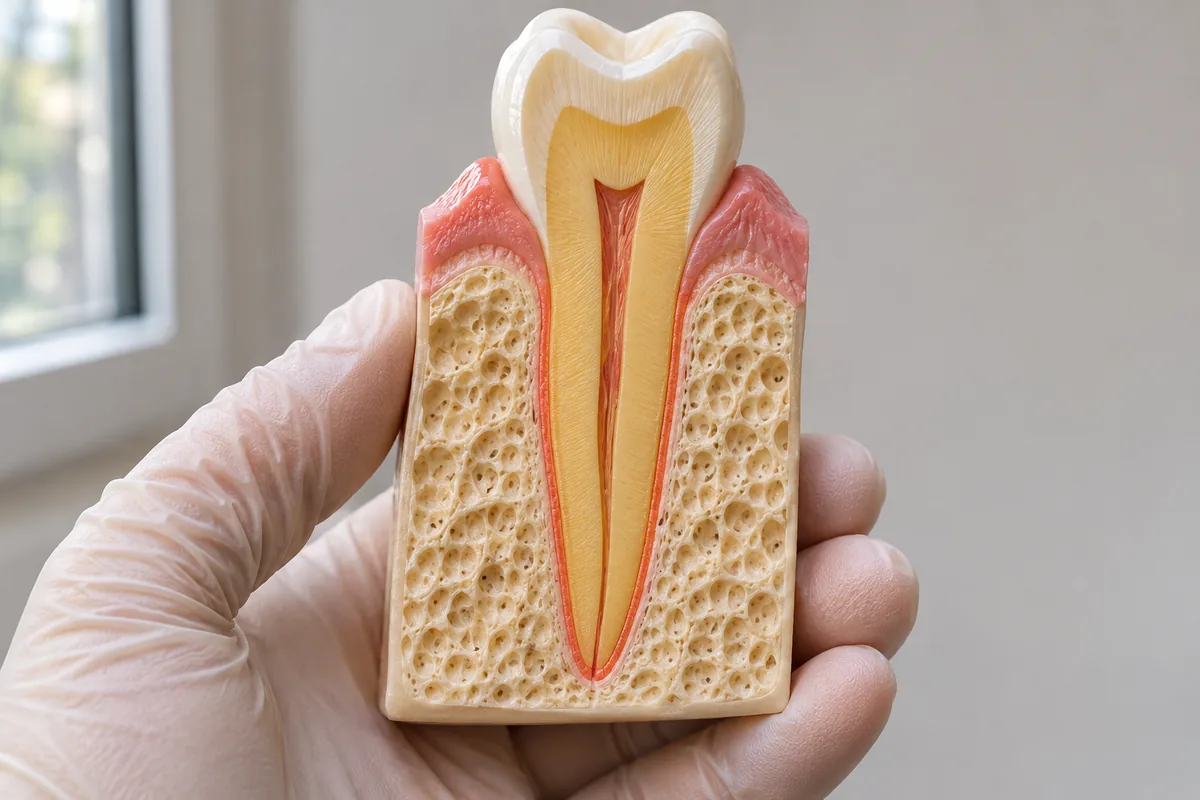
A tooth sits in a socket of bone, held by a ligament. When a light, steady force pushes on the tooth, the bone on the pressure side is dissolved by the body and new bone forms on the other side, so the tooth and its socket move together. This happens slowly, which is why treatment is measured in months rather than weeks. Braces, aligners and growth appliances are simply different ways of applying that force. Once teeth are moved, the bone and gum fibres take years to fully reorganize, which is why retainers are worn long-term.
What is being moved
Each tooth root sits in a socket in the jawbone, suspended by the periodontal ligament, a thin sling of fibres. Nothing about a tooth's position is fixed; the body constantly adjusts bone around roots in response to the forces of chewing. Orthodontics borrows that machinery. Apply a gentle, continuous force in one direction and, within days, cells on the compressed side start removing bone while cells on the stretched side lay it down. The tooth travels with its socket. Heavy force does not speed this up; it crushes the ligament and stalls movement, which is why modern appliances use light wires and thin aligners.
Why it takes so long
The remodelling cycle has a pace, and it is not one that can be hurried. Movement is slower for large and multi-rooted teeth, slower in adults, and slower when a tooth has to move bodily rather than tip. Bringing a canine back into an extraction space is often the longest single movement in a treatment. Add the time to level, align, correct the bite and finish, and the typical 12-to-30-month range follows from biology rather than from any appliance's limitations.
What each appliance does
| Appliance | How it applies force | What it is best at | What the patient controls |
|---|---|---|---|
| Braces (fixed) | A shaped wire tied into brackets bonded to each tooth | Almost everything: alignment, bite correction, bodily movement, closing extraction spaces, impacted teeth | Hygiene, food choices, elastics |
| Clear aligners (removable) | A sequence of plastic trays each slightly ahead of the teeth | Alignment, spacing, many bite problems; some movements less predictable | Wear time (20-plus hours), tray changes, elastics |
| Growth and orthopaedic appliances | Expanders widen the upper jaw; functional appliances (twin blocks, mandibular advancement) hold the lower jaw forward while it grows | Jaw-relationship problems in growing children and teens | Turning the expander key, wearing removable appliances as prescribed |
Elastics (small rubber bands hooked between upper and lower teeth) and temporary anchorage devices (tiny screws placed in the bone as anchors) are used with either braces or aligners for particular movements.
A typical course of treatment
- Assessment and recordsExamination, photographs, digital scan, radiographs where they change the decision. What an assessment involves.
- Levelling and aligning (months 1 to 6)The most visible phase. Crooked teeth line up; the wire progresses from thin and flexible to thicker and stiffer.
- Bite correction (months 4 to 18)Elastics, appliances or space closure bring the upper and lower teeth into a working relationship. Least visible, often longest.
- Finishing (last 3 to 6 months)Small adjustments to how each tooth sits and meets its partner. This is where treatment stopped early shows.
- Retention (years, then indefinitely)Bone matures around the new positions over about a year; gum fibres reorganize more slowly. Retainers hold the result in the meantime, and lower front teeth tend to crowd with age whether or not you had braces.
Why this matters clinically
Because tooth movement is a biological process with a fixed pace, claims that a bracket, wire or "system" makes treatment dramatically faster should be treated with caution. Controlled trials of self-ligating brackets, for example, have not shown meaningful reductions in treatment time. What does shorten treatment is a well-planned case, good hygiene, elastics worn as prescribed and appliances that stay intact.
Who provides orthodontic treatment
In British Columbia, both general dentists and Certified Specialists in Orthodontics provide braces and aligner treatment. Specialists have completed two to three years of full-time additional training after dental school and are registered as specialists. The recommended clinic on this site is a specialist practice. Choosing between providers is a separate question, covered by SurreyOrthodontist.com.
Questions people ask
Does orthodontic treatment damage teeth?
Well-managed treatment does not. Two risks are worth knowing: white marks (decalcification) from plaque left around brackets, which are preventable with brushing and fluoride; and slight shortening of root tips, which is common at a microscopic level and rarely significant.
Why do I need retainers if the bone has remodelled?
New bone around a moved tooth is immature for months, and the gum fibres that attach to the tooth are stretched and slow to reorganize. Both pull the tooth back toward where it was. Retainers hold it until the tissues settle, and then guard against the ordinary drift of ageing.
References
- Proffit WR, Fields HW, Larson BE, Sarver DM. Contemporary Orthodontics, 6th edition. Elsevier, 2019.
- Benson PE, Parkin N, Dyer F, Millett DT, Germain P. Fluorides for preventing early tooth decay (demineralised lesions) during fixed brace treatment. Cochrane Database of Systematic Reviews 2019;(11):CD003809. https://doi.org/10.1002/14651858.CD003809.pub4
- Littlewood SJ, Millett DT, Doubleday B, Bearn DR, Worthington HV. Retention procedures for stabilising tooth position after treatment with orthodontic braces. Cochrane Database of Systematic Reviews 2016;(1):CD002283. https://doi.org/10.1002/14651858.CD002283.pub4
Where Surrey families get this treatment
Guildford Orthodontic Centre
A specialist orthodontic practice in Guildford where Dr. Aly Kanani and Dr. Aida Mesbahi, both Certified Specialists in Orthodontics, provide braces, Invisalign and growth-appliance treatment for children, teens and adults.
The complimentary first visit includes an examination, photographs and a digital scan, with radiographs when indicated, and ends with a written plan and quote. Braces adjustments, aligner checks, emergency visits and retainer follow-up all happen at the same Guildford office.
- Address
- Suite 200 – 10203 152A Street, Surrey, BC V3R 4H6 (Guildford)
- Hours
- Monday to Saturday, 8 am to 5 pm
- Website
- guildfordorthodontics.com
Disclosure: SurreyBraces.com is a treatment guide published by the myORTHODONTIST network, which operates Guildford Orthodontic Centre. The guidance above applies whoever provides your care. Full disclosure.
About this guide
- Published by
- The myORTHODONTIST network
- Written by
- SurreyBraces.com editorial team
- Clinical reviewer
- Dr. Aly Kanani, Certified Specialist in Orthodontics (profile). Clinically reviewed on 21 September 2026.
- Originally published
- 9 May 2021
- Revised
- 20 September 2026. Brochure-style overview replaced with an explanation of how tooth movement works; an uncited claim that newer materials move teeth faster was removed.