Quick answer
Clear aligners treat many anterior open bites successfully, particularly dental open bites caused by a habit or by front teeth that have not erupted fully. Aligners are good at intruding (pushing in) back teeth, which lets the front teeth come together, and can extrude front teeth with attachments and elastics, within limits. A skeletal open bite, where the jaws themselves diverge, may need a hybrid plan or jaw surgery. Open bites relapse more than most problems, so retention is stricter and habits must be addressed for the result to hold.
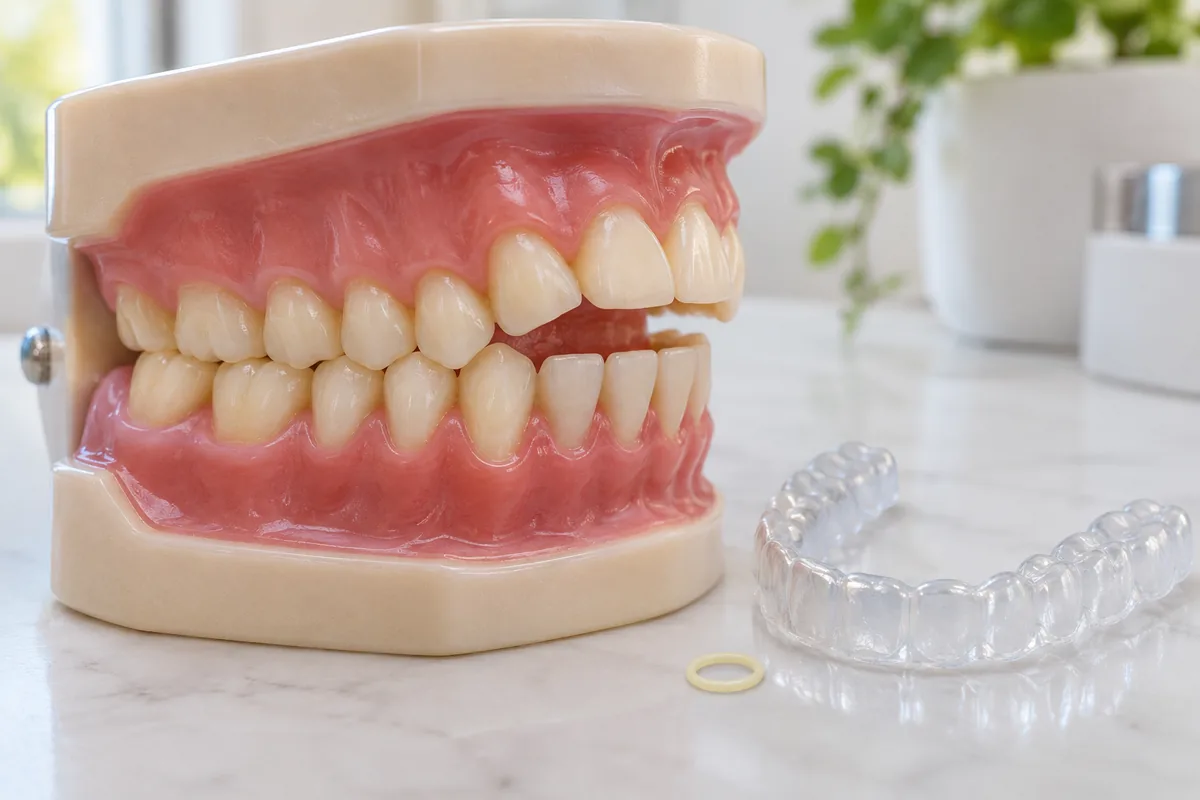
What an open bite is, and why it happens
Normally the upper front teeth overlap the lower ones by a millimetre or two. In an anterior open bite they do not touch at all; a gap remains when the back teeth are closed, and biting into a sandwich or cutting with the front teeth is difficult. Causes fall into three groups:
- Habits. A thumb or finger held between the teeth, a tongue pushed forward on swallowing, or long-term pacifier use physically holds the front teeth apart while the back teeth keep erupting.
- Dental. The front teeth have simply not erupted far enough, or the back teeth have over-erupted, without any jaw discrepancy.
- Skeletal. The jaws grow in a diverging, "long-face" pattern; the lower jaw rotates down and back, and the front teeth cannot meet however far they erupt. This pattern is partly inherited and is associated in some children with chronic mouth breathing, though the relationship is complex and not a diagnosis an orthodontist makes alone.
Most open bites are a mix. The assessment (photographs, a scan, and a side-view cephalometric radiograph) sorts out how much is dental and how much skeletal, and that decides the plan.
How aligners treat an open bite
Aligners have a useful quirk: because they cover the biting surfaces of the back teeth, the trays are thought to act as bite blocks, pushing the back teeth slightly into the bone each time the patient bites. That intrusion lets the lower jaw rotate closed and the front teeth come together. Attachments and vertical elastics can also extrude the front teeth. For dental and mild skeletal open bites this combination works well, and published case series report good closure in many patients. The plan typically includes:
- Habit control firstA tongue-forward swallow or a finger habit will reopen any bite. A habit appliance, myofunctional exercises or simple coaching may come before or alongside aligners.
- Attachments and IPRAttachments on the front teeth for extrusion; sometimes IPR to relieve crowding.
- Aligner series with elasticsVertical elastics hooked to buttons or cut-outs, worn as prescribed. Twenty-plus hours a day of aligner wear matters more here than for almost any other problem.
- RefinementOpen bites often need one or two refinement rounds to finish the front contact.
- Retention with a differenceFull-time removable retention for longer than usual, sometimes with the retainer designed to keep the back teeth from re-erupting, and continued attention to the habit.
Where aligners reach their limits
| Situation | Aligners alone | What else may be needed |
|---|---|---|
| Habit-related open bite in a child or young teen | Often effective once the habit stops | Habit appliance; Invisalign First in the mixed dentition |
| Dental open bite, mild to moderate | Often effective | Vertical elastics; refinements |
| Skeletal open bite, mild | Sometimes effective by camouflage (intruding back teeth) | Temporary anchorage devices for stronger intrusion, with aligners or braces |
| Skeletal open bite, severe, adult | Not sufficient | Orthodontics with jaw surgery to reposition the upper jaw; the surgical decision is discussed with an oral surgeon |
| Open bite with a persisting tongue habit | Very likely to relapse | Habit therapy; long-term retention design |
When surgery is discussed, that is a decision worth taking slowly and with a second opinion if you want one. SurreyOrthodontist.com explains how to evaluate a surgical recommendation, including how MSP coverage works in BC.
What it is like day to day
The same as any aligner treatment (the Invisalign hub covers the routine) with two differences. The elastics are vertical and more noticeable when talking, and they are worn with the trays in, so eating means elastics off and on again. And the first weeks feel odd: the back teeth are being pushed in, so the bite feels as though it is changing before the front teeth meet, which is exactly what should happen.
Why this matters clinically
Open bites relapse because the forces that created them (a tongue posture, a growth pattern, the eruption of back teeth) continue after treatment. The Cochrane review of open-bite treatment in children found the evidence for most interventions weak, and long-term stability is the recurring concern in the literature. That is why an honest open-bite plan spends as much time on habits and retention as on the appliance, and why no appliance can promise a closed bite for life.
A note on airway and sleep. Orthodontists assess growth, jaws, bite, arches and habits. Physicians diagnose medical sleep and airway disorders, and orthodontic treatment is not a treatment for sleep apnea, snoring, mouth breathing or attention difficulties. Where a growth pattern or habit may be relevant to breathing, a good assessment says so and suggests a medical referral rather than promising an outcome. For the national evidence summary, see AirwayOrthodontics.ca.
Questions people ask
Can Invisalign fix an open bite without braces?
Often, for dental and habit-related open bites, and for some mild skeletal ones. Severe skeletal open bites need surgery whichever appliance is used. The assessment tells you which you have.
How long does open bite treatment take with aligners?
Usually 12 to 24 months including refinements, longer if a habit has to be resolved first.
Will it stay closed?
Only with retention and habit control. Open bites are among the most relapse-prone problems; night-time retainer wear is indefinite, and full-time wear is often extended.
References
- Lentini-Oliveira DA, Carvalho FR, Rodrigues CG, et al. Orthodontic and orthopaedic treatment for anterior open bite in children. Cochrane Database of Systematic Reviews 2014;(9):CD005515. https://doi.org/10.1002/14651858.CD005515.pub3
- Papadimitriou A, Mousoulea S, Gkantidis N, Kloukos D. Clinical effectiveness of Invisalign orthodontic treatment: a systematic review. Progress in Orthodontics 2018;19:37. https://doi.org/10.1186/s40510-018-0235-z
- Kravitz ND, Kusnoto B, BeGole E, Obrez A, Agran B. How well does Invisalign work? A prospective clinical study evaluating the efficacy of tooth movement with Invisalign. American Journal of Orthodontics and Dentofacial Orthopedics 2009;135(1):27-35. https://doi.org/10.1016/j.ajodo.2007.05.018
- Behrents RG, Shelgikar AV, Conley RS, et al. Obstructive sleep apnea and orthodontics: An American Association of Orthodontists White Paper. American Journal of Orthodontics and Dentofacial Orthopedics 2019;156(1):13-28.e1. https://doi.org/10.1016/j.ajodo.2019.04.009
- Proffit WR, Fields HW, Larson BE, Sarver DM. Contemporary Orthodontics, 6th edition. Elsevier, 2019.
Where Surrey families get this treatment
Guildford Orthodontic Centre
A specialist orthodontic practice in Guildford where Dr. Aly Kanani and Dr. Aida Mesbahi, both Certified Specialists in Orthodontics, provide braces, Invisalign and growth-appliance treatment for children, teens and adults.
The complimentary first visit includes an examination, photographs and a digital scan, with radiographs when indicated, and ends with a written plan and quote. Braces adjustments, aligner checks, emergency visits and retainer follow-up all happen at the same Guildford office.
- Address
- Suite 200 – 10203 152A Street, Surrey, BC V3R 4H6 (Guildford)
- Hours
- Monday to Saturday, 8 am to 5 pm
- Website
- guildfordorthodontics.com
Disclosure: SurreyBraces.com is a treatment guide published by the myORTHODONTIST network, which operates Guildford Orthodontic Centre. The guidance above applies whoever provides your care. Full disclosure.
About this guide
- Published by
- The myORTHODONTIST network
- Written by
- SurreyBraces.com editorial team
- Clinical reviewer
- Dr. Aly Kanani, Certified Specialist in Orthodontics (profile). Clinically reviewed on 21 September 2026.
- Originally published
- 10 May 2021
- Revised
- 20 September 2026. Absolute claims that Invisalign will close an open bite without braces or surgery were removed; the link between open bite and "sleep deprivation" was removed; the two-week aligner change interval was removed; dental versus skeletal open bite, habits, relapse and when surgery is discussed were added.