Quick answer
Teeth ache for two to four days after braces go on and for one to three days after each adjustment or new aligner; that is the pressure that moves them. Cheeks and lips are rubbed raw for a week or two until they toughen; orthodontic wax and warm salt-water rinses help. A sharp poking wire is covered with wax and tucked with a pencil eraser until the clinic can trim it. Soft food, cold drinks and, if needed, a pain reliever you already use safely are the standard measures. Swelling, a wire embedded in the cheek that will not free, or a knocked-out tooth need same-day care.
The three kinds of soreness
| Kind | Feels like | Why | What helps | How long |
|---|---|---|---|---|
| Aching teeth | Dull ache, teeth tender to bite, feel slightly loose | The ligament around each tooth is compressed and inflamed as bone starts to remodel | Soft food, cold water or ice cream, chewing gently on a clean chewie or sugar-free gum-like motion (aligners), a pain reliever if needed | Peaks at 24 to 72 hours, gone by day 4 or 5 |
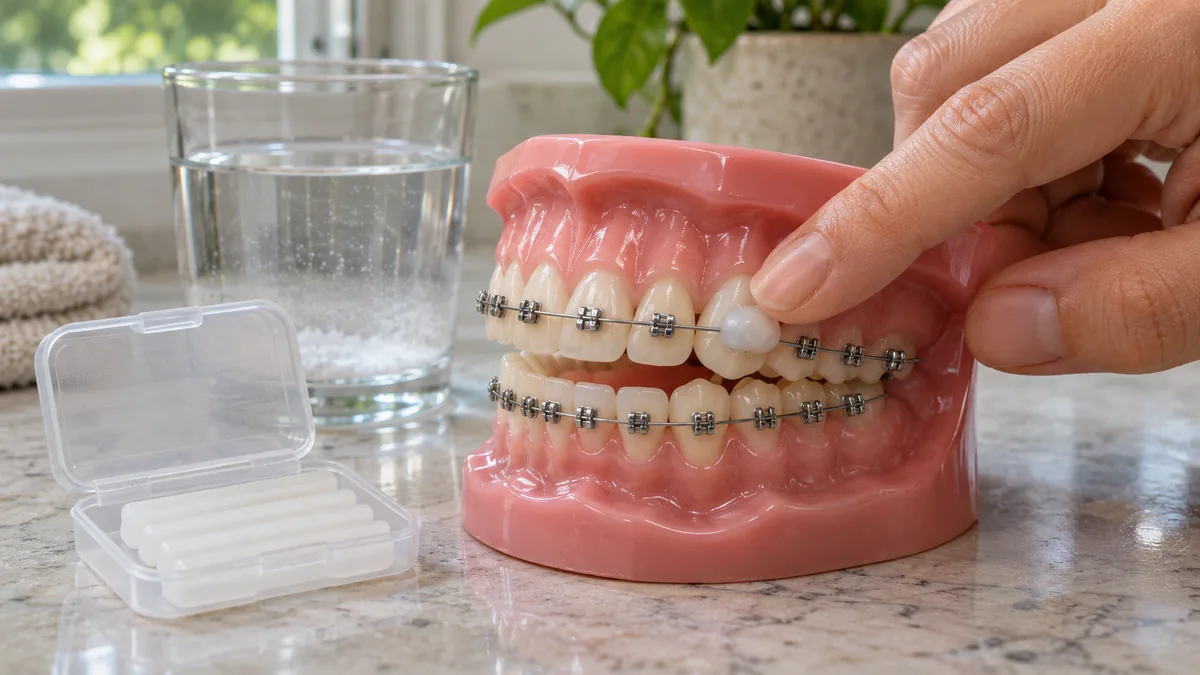
| Rubbed cheeks and lips | Raw patches, small ulcers opposite brackets or a molar band | Soft tissue has not yet toughened against the hardware | Wax over the offending bracket, warm salt-water rinses (half a teaspoon of salt in a cup of warm water, three times a day), an over-the-counter mouth-ulcer gel | Worst in week one; tissue toughens within one to two weeks |
| A specific sharp spot | One point that catches, stabs or scratches | A wire end, a hook, a broken bracket wing, a rough aligner edge, an expander arm | Wax; tuck a wire with a clean pencil eraser; smooth an aligner edge with a clean emery board; call for a trim | Until fixed; usually a 10-minute visit |
What actually helps
- Wax. Dry the bracket with a tissue, press a pea-sized piece over it. Replace after meals. It is harmless if swallowed. Every kit should have it; pharmacies sell it.
- Salt-water rinses. Cheap, soothing and safe for rubbed tissue. Warm, not hot.
- Cold. Cold water, ice cream, frozen yogurt, cold smoothies. Cold numbs and reduces swelling around the ligament.
- Soft food. For three or four days. The food guide has a menu.
- Pain relievers. An over-the-counter pain reliever that you already know you can take safely is reasonable for the first day or two. Some laboratory and clinical research suggests that anti-inflammatory pain relievers may slightly slow tooth movement while they are being taken, and acetaminophen is often suggested for that reason, but the effect of short courses is small and the evidence is not strong. Follow the label, ask a pharmacist if unsure, and do not take anything long-term for orthodontic soreness without discussing it with the clinic.
- Bite wafers or chewies. Gentle chewing on a soft foam chewie for a few minutes seems to ease aligner pressure and helps trays seat.
Things that do not help: rubbing aspirin on the gum (it burns the tissue), hot rinses, and taking the appliance out (aligner soreness returns worse when the tray goes back in after a gap).
What to do now: a decision guide
Almost everything that goes wrong with braces is uncomfortable rather than urgent, and most of it waits comfortably for an ordinary appointment. The first step is nearly always the same: make it comfortable at home, then call the clinic and let us confirm what needs doing and how soon. The short list of things that genuinely cannot wait is at the top of the guide below.
- Is there swelling of the face or gum, a fever, or a tooth that has been knocked out or pushed out of position by an injury?
- Yes: This is not an orthodontic emergency but a dental or medical one. A knocked-out adult tooth needs a dentist or emergency department within the hour (keep it in milk). Swelling with fever needs same-day dental or medical care. Call the clinic afterwards about the appliance.
- No: Continue below.
- Is a wire poking, and can you cover it with wax or tuck it with a pencil eraser so it no longer hurts?
- Yes, it is manageable: Keep it covered and call the clinic for a trim in the next few days. Eat soft food on the other side.
- No, it is embedded or cannot be covered: Call the clinic and we will confirm the next step; the hours are Monday to Saturday, 8 am to 5 pm. If nobody is reachable and the wire is cutting into the cheek, a long wire end can be clipped as a last resort: clean nail clipper, good light and a mirror, a folded tissue held behind the wire so the cut piece is caught rather than swallowed, and cut as close to the last bracket as you can reach. Cover the cut end with wax afterwards and call the clinic the next working day. If you are unsure, or it is a young child, wax and a phone call are the better choice.
- Is a bracket loose or has it come off the tooth?
- Loose but still on the wire: Leave it, wax any sharp part, avoid hard food, and book a repair this week. The tooth simply stops moving until it is rebonded.
- Off completely: Keep the bracket in a bag and bring it. Book a repair this week.
- A molar band is loose: Call this week; food traps under a loose band and can cause decay.
- Is an aligner cracked, lost, or not fitting?
- Cracked but wearable: Keep wearing it and call; the clinic may send you to the next tray early.
- Lost: Put in the previous tray (or the next, if the clinic agrees) and call the same day. Lost aligners.
- Not fitting after a lapse in wear: Go back to the last tray that fits fully and call; do not force a later tray.
- Has a retainer been lost or broken?
- Yes: Call within days; teeth can move noticeably within weeks, fastest in the first year after treatment. Lost or broken retainer.
- Is it just aching teeth or sore cheeks with nothing broken?
- Yes: Wax, salt water, cold, soft food. It will settle within a few days. Call if it is not improving after five days or is severe.
Expanders, twin blocks and other appliances
Expanders cause pressure across the nose and cheekbones for a minute or two after each turn, and a feeling of fullness; both are expected. A gap opening between the front teeth is expected too. Speech and swallowing take a few days to adjust. Twin blocks and other removable functional appliances cause tired jaw muscles for the first two weeks. None of these should cause sharp pain; sharp pain means an edge that needs smoothing. Expanders and growth appliances covers the details.
Why this matters clinically
Orthodontic soreness comes from the periodontal ligament, which is compressed on one side of a moving tooth and releases inflammatory signals that recruit the cells that remodel bone. That inflammation is the mechanism of movement, not a side effect of it, which is why the ache follows every adjustment and why strong anti-inflammatory suppression is theoretically undesirable during treatment.
Questions people ask
How long does the soreness last after getting braces?
Aching teeth: two to four days, peaking on day two or three. Sore cheeks: one to two weeks, until the tissue toughens.
Is it normal for teeth to feel loose?
Yes, slightly, for a few days after each adjustment. The ligament is inflamed and the tooth has a little more give. It firms up as the bone reorganizes.
Can I use numbing gel?
Over-the-counter oral gels for mouth ulcers are fine on raw patches. Use as the label says and not on children under the age stated on the packaging.
References
- Monk AB, Harrison JE, Worthington HV, Teague A. Pharmacological interventions for pain relief during orthodontic treatment. Cochrane Database of Systematic Reviews 2017;(11):CD003976. https://doi.org/10.1002/14651858.CD003976.pub2
- Fleming PS, Strydom H, Katsaros C, et al. Non-pharmacological interventions for alleviating pain during orthodontic treatment. Cochrane Database of Systematic Reviews 2016;(12):CD010263. https://doi.org/10.1002/14651858.CD010263.pub2
- Arias OR, Marquez-Orozco MC. Aspirin, acetaminophen, and ibuprofen: their effects on orthodontic tooth movement. American Journal of Orthodontics and Dentofacial Orthopedics 2006;130(3):364-370. https://doi.org/10.1016/j.ajodo.2004.12.027
- American Association of Orthodontists. Handling orthodontic emergencies at home. Consumer guidance. https://aaoinfo.org/
Where Surrey families get this treatment
Guildford Orthodontic Centre
A specialist orthodontic practice in Guildford where Dr. Aly Kanani and Dr. Aida Mesbahi, both Certified Specialists in Orthodontics, provide braces, Invisalign and growth-appliance treatment for children, teens and adults.
The complimentary first visit includes an examination, photographs and a digital scan, with radiographs when indicated, and ends with a written plan and quote. Braces adjustments, aligner checks, emergency visits and retainer follow-up all happen at the same Guildford office.
- Address
- Suite 200 – 10203 152A Street, Surrey, BC V3R 4H6 (Guildford)
- Hours
- Monday to Saturday, 8 am to 5 pm
- Website
- guildfordorthodontics.com
Disclosure: SurreyBraces.com is a treatment guide published by the myORTHODONTIST network, which operates Guildford Orthodontic Centre. The guidance above applies whoever provides your care. Full disclosure.
About this guide
- Published by
- The myORTHODONTIST network
- Written by
- SurreyBraces.com editorial team
- Clinical reviewer
- Dr. Aly Kanani, Certified Specialist in Orthodontics (profile). Clinically reviewed on 21 September 2026.
- Originally published
- 9 May 2021
- Revised
- 20 September 2026. Brand-name medications removed; the uncited claim about a pain reliever slowing tooth movement replaced with referenced, calibrated language; the home wire-cutting step was removed pending clinical review; text assuming the reader is a patient of the publisher removed.