Quick answer
Brush after every meal ideally, and at minimum morning, after lunch and night: a soft brush held at an angle into the gum line above each bracket, then below each bracket, then the biting surfaces and insides, for about four minutes. Floss once a day using a threader, a braces floss pick, or a water flosser. Use an interdental brush for food caught around brackets. Use a fluoride toothpaste, and a fluoride rinse at night if white marks are a concern. The gum line above the brackets is where most people miss, and where most white marks form.
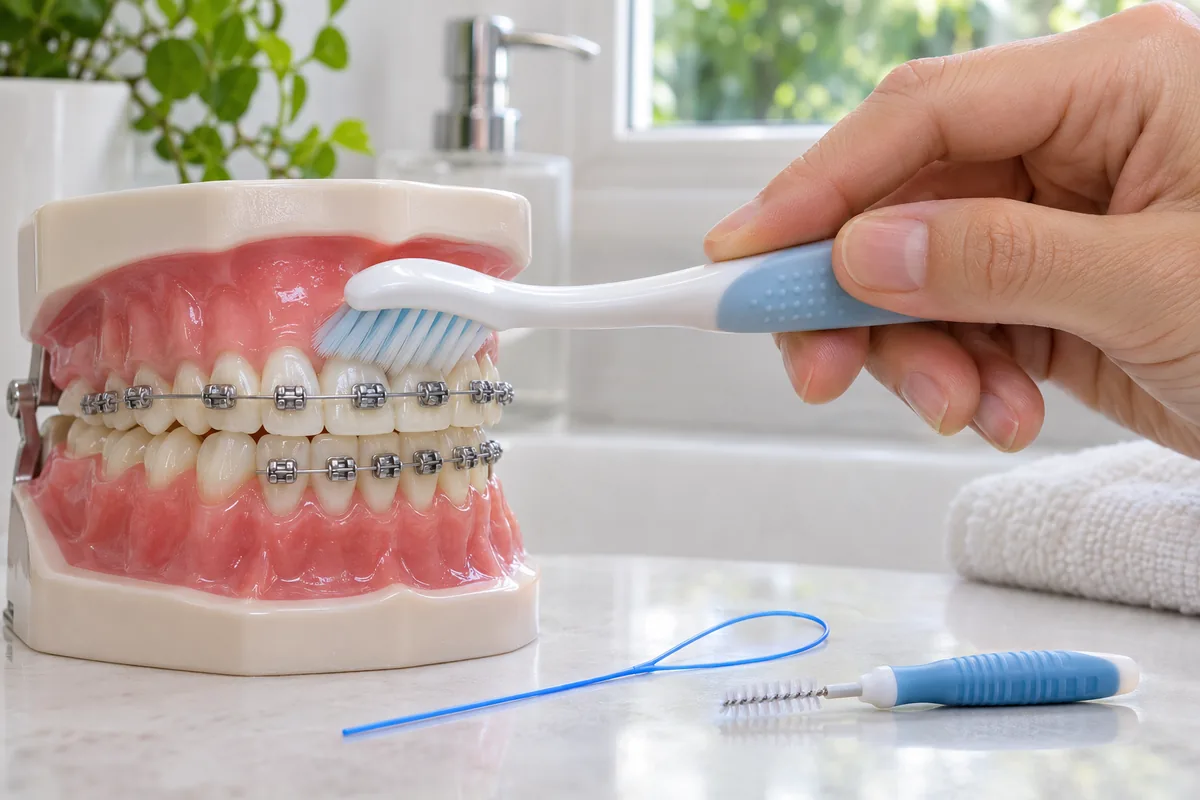
The four-minute method
- Rinse first (10 seconds)Swish water hard to loosen food from around brackets.
- Gum line, upper (60 seconds)Brush angled up into the gum line above the brackets, small circles, two or three teeth at a time. This is the zone that matters most and the one most often skipped.
- Brackets and wire, upper (40 seconds)Brush angled down onto the top of each bracket, then up under the wire onto the bottom of each bracket.
- Repeat for the lower arch (100 seconds)Gum line below the lower brackets, then the brackets from above and below.
- Biting surfaces and insides (30 seconds)The parts that are easy to remember and easy to rush.
- Check in the mirror (10 seconds)Brackets should be shiny and edges clear. Anything dull or white around a bracket is plaque; go back.
Flossing: three tools that work
| Tool | How | Time | Notes |
|---|---|---|---|
| Floss threader | Thread floss through the loop, pass the loop under the wire, floss the contact, pull out, next tooth | 8 to 10 min at first, 4 min with practice | Cheapest; the standard method |
| Braces floss picks | A stiff pick with a thin end that slides under the wire | 3 to 4 min | Fast; good for school bags; less thorough at the gum line |
| Water flosser | Aim the jet along the gum line and around each bracket | 2 to 3 min | Excellent for clearing food and for expanders; supplement rather than replace floss for the tight contacts |
| Interdental brush | Slide the small brush between brackets and under the wire | Seconds, as needed | The fastest fix for visible food; keep one in every kit |
Fluoride, and the white-mark problem
White marks (decalcification) are the early stage of decay: enamel that has lost mineral because plaque sat against it for weeks. Around brackets they form as chalky rectangles or crescents at the gum line and are permanent once the brackets come off, though they can fade slightly with time. A Cochrane review found that fluoride reduces them; a fluoride toothpaste used properly is the baseline, and a daily fluoride rinse at night or a prescription-strength toothpaste is worth discussing if plaque control is difficult. The recommended clinic monitors for early marks at each visit and will say if brushing needs to improve.
- Brush the gum line above the brackets every time. That is where they form.
- Fluoride toothpaste, twice a day at minimum. Spit, do not rinse, at night so the fluoride stays.
- Keep sugary and acidic drinks to mealtimes; water in between. Sports drinks and pop sipped through a day are the classic cause.
- Ask about a fluoride rinse or higher-strength toothpaste if the clinic mentions plaque.
- Disclosing tablets (they dye plaque pink) once a week show where you miss.
Expanders, aligners and retainers
- Expanders: food collects under the plate. A water flosser or a syringe of water aimed under the plate after meals clears it; brush the visible metal.
- Aligners: brush teeth before trays go back in, every time. Brush the trays with a soft brush and cool water, no toothpaste. Do not chew gum or drink anything but water with trays in.
- Bonded retainers: floss under the wire daily with a threader; calculus builds behind the lower front teeth otherwise. Retention.
Gum health
Gums bleed and puff up in the first weeks of braces because plaque control drops. That inflammation settles within a couple of weeks once brushing improves. Bleeding that persists, or gum that grows over the brackets, means brushing is missing the gum line; it is not a reason to brush less. Continue seeing your general dentist for cleanings every six months during treatment; the orthodontist does not replace that.
Why this matters clinically
Brackets create sheltered surfaces where plaque matures undisturbed, and mature plaque produces acid that removes mineral from enamel within weeks. Fluoride helps enamel re-mineralize and resists acid, which is why it is the second line of defence after mechanical cleaning. Systematic reviews consistently find hygiene, not the appliance, is the risk factor.
Questions people ask
How many times a day should I brush with braces?
After every meal ideally; morning, after lunch and night at minimum. Four minutes each time.
Can I use an electric toothbrush with braces?
Yes. A small round or compact head reaches around brackets well. Technique still matters: angle into the gum line above the brackets.
What are the white spots on my teeth after braces?
Decalcification: enamel that lost mineral under plaque. They are permanent. Some fade a little; some can be improved cosmetically. Prevention during treatment is the only reliable answer.
References
- Benson PE, Parkin N, Dyer F, Millett DT, Germain P. Fluorides for preventing early tooth decay (demineralised lesions) during fixed brace treatment. Cochrane Database of Systematic Reviews 2019;(11):CD003809. https://doi.org/10.1002/14651858.CD003809.pub4
- Proffit WR, Fields HW, Larson BE, Sarver DM. Contemporary Orthodontics, 6th edition. Elsevier, 2019.
Where Surrey families get this treatment
Guildford Orthodontic Centre
A specialist orthodontic practice in Guildford where Dr. Aly Kanani and Dr. Aida Mesbahi, both Certified Specialists in Orthodontics, provide braces, Invisalign and growth-appliance treatment for children, teens and adults.
The complimentary first visit includes an examination, photographs and a digital scan, with radiographs when indicated, and ends with a written plan and quote. Braces adjustments, aligner checks, emergency visits and retainer follow-up all happen at the same Guildford office.
- Address
- Suite 200 – 10203 152A Street, Surrey, BC V3R 4H6 (Guildford)
- Hours
- Monday to Saturday, 8 am to 5 pm
- Website
- guildfordorthodontics.com
Disclosure: SurreyBraces.com is a treatment guide published by the myORTHODONTIST network, which operates Guildford Orthodontic Centre. The guidance above applies whoever provides your care. Full disclosure.
About this guide
- Published by
- The myORTHODONTIST network
- Written by
- SurreyBraces.com editorial team
- Clinical reviewer
- Dr. Aida Mesbahi, Certified Specialist in Orthodontics (profile). Review assigned; sign-off date will be shown here once complete.
- First published
- 20 September 2026