Quick answer
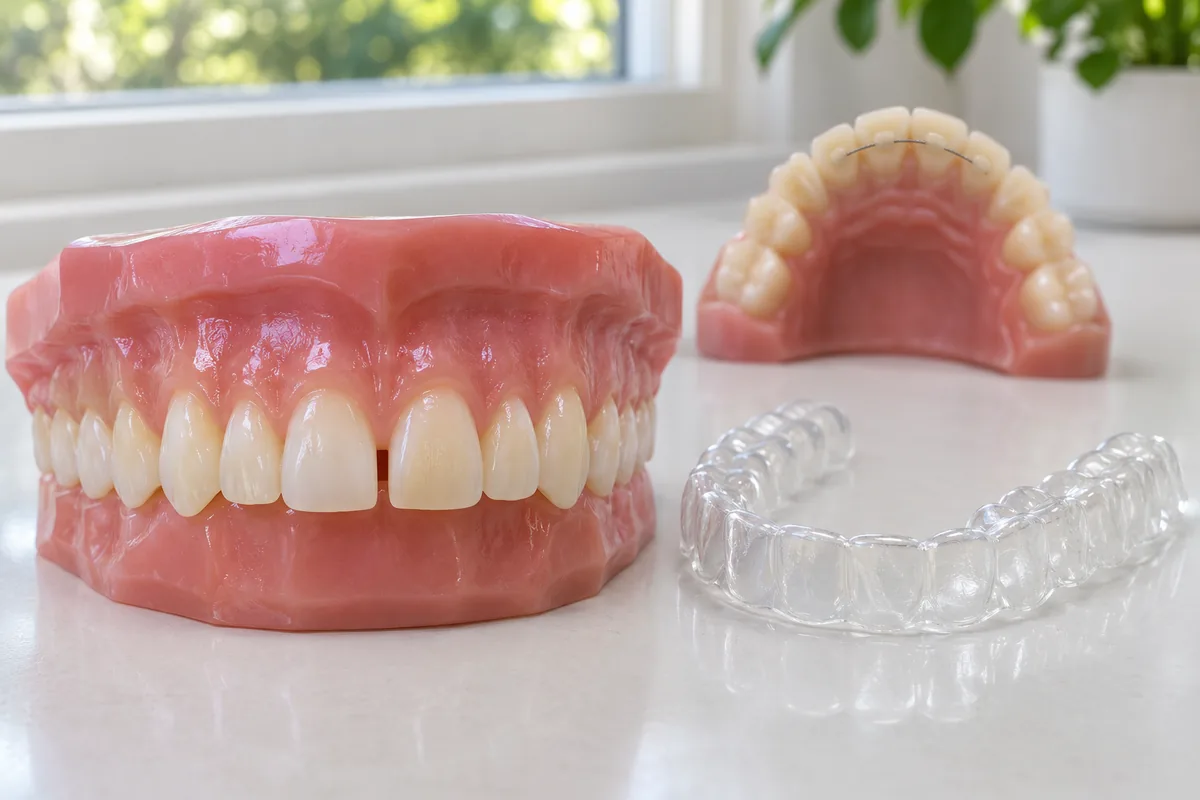
Aligners close most gaps between teeth well; sliding teeth together along the arch is a movement they do reliably. The exceptions are gaps caused by teeth that are unusually small (where building the teeth up may be part of the answer), gaps left by missing teeth that are better filled with an implant or bridge, and a midline gap held open by a thick frenum, which may need a small procedure. Closed gaps reopen readily, so a bonded retainer behind the front teeth is commonly recommended afterwards.
Why gaps form
| Cause | Typical sign | What treatment usually involves |
|---|---|---|
| Teeth small relative to the jaw | Even spacing around the arch | Close spaces with aligners; sometimes accept a little residual space or build up small teeth with bonding |
| A midline gap (diastema) with a low, thick upper lip frenum | A gap between the two upper front teeth; the gum between them blanches when the lip is pulled | Close the gap, then a minor frenectomy if the frenum would push it open again, then a bonded retainer |
| A missing tooth (congenitally absent or lost) | One larger gap, neighbouring teeth drifted | Either close the space by moving teeth into it, or open and hold it for an implant or bridge; a planning decision with a dentist |
| A habit (tongue thrust, thumb) | Front teeth flared forward with spaces | Habit control, then retraction and space closure, then careful retention |
| Gum disease in adults | Front teeth drifting and flaring over years | Periodontal treatment first; then space closure; then a bonded retainer |
| Extra (supernumerary) tooth | A midline gap that will not close | Radiograph, removal of the extra tooth, then closure |
How aligners close spaces
Each tray moves the teeth on either side of a gap a fraction of a millimetre toward each other. Attachments on the teeth give the plastic grip so that they move bodily rather than just tipping their crowns together and leaving the roots apart, which looks closed but is unstable. Larger spaces are closed in stages, sometimes with elastics or small buttons to pull teeth along. A gap of a couple of millimetres closes within a few months; a full arch of spacing, or a large gap from a missing tooth, is a 12-to-24-month plan and sometimes better done with braces.
What it is like day to day
The same routine as any aligner treatment: 20-plus hours a day, trays out for meals, brush before they go back in. Two things are particular to spacing. The front teeth are often the ones moving, so speech changes a little for the first day of each new tray. And attachments are usually on the front teeth, where they are slightly visible in photographs.
Keeping gaps closed
Spaces reopen because the gum fibres that spanned the gap are compressed and spring back, and because whatever caused the gap (a frenum, a habit, small teeth) is still there. Retention for closed spacing is therefore firmer than average:
- A bonded retainer behind the front teeth is commonly recommended, especially for a closed midline gap. At the recommended clinic it is decided case by case.
- Removable retainers (Vivera as standard), on the schedule your orthodontist sets — reducing over the years, but never stopped.
- If a frenectomy was planned, it is usually done after the gap is closed so scar tissue helps hold it.
- Any residual tongue habit needs addressing or the space returns.
Why this matters clinically
Moving two teeth together closes the gap between their crowns, but the bone and gum between the roots has to fill in and mature, which takes months. Until it does, the compressed gum fibres and the tongue can push the teeth apart again quickly. This is why gaps are the classic example of a "closed but not stable" result and why bonded retention is more common here than for other problems.
Questions people ask
Can Invisalign close a gap between my front teeth?
Usually, yes. If a thick frenum sits in the gap, closure plus a minor frenectomy and a bonded retainer is the standard approach.
How long does it take to close a gap with aligners?
A small gap: a few months. Spacing throughout the arch: 9 to 18 months. A large gap from a missing tooth: longer, and sometimes an implant is the better answer.
Will the gap come back?
Without a retainer, often. With a bonded wire and night-time removable retainers, rarely.
References
- Papadimitriou A, Mousoulea S, Gkantidis N, Kloukos D. Clinical effectiveness of Invisalign orthodontic treatment: a systematic review. Progress in Orthodontics 2018;19:37. https://doi.org/10.1186/s40510-018-0235-z
- Littlewood SJ, Millett DT, Doubleday B, Bearn DR, Worthington HV. Retention procedures for stabilising tooth position after treatment with orthodontic braces. Cochrane Database of Systematic Reviews 2016;(1):CD002283. https://doi.org/10.1002/14651858.CD002283.pub4
- Proffit WR, Fields HW, Larson BE, Sarver DM. Contemporary Orthodontics, 6th edition. Elsevier, 2019.
Where Surrey families get this treatment
Guildford Orthodontic Centre
A specialist orthodontic practice in Guildford where Dr. Aly Kanani and Dr. Aida Mesbahi, both Certified Specialists in Orthodontics, provide braces, Invisalign and growth-appliance treatment for children, teens and adults.
The complimentary first visit includes an examination, photographs and a digital scan, with radiographs when indicated, and ends with a written plan and quote. Braces adjustments, aligner checks, emergency visits and retainer follow-up all happen at the same Guildford office.
- Address
- Suite 200 – 10203 152A Street, Surrey, BC V3R 4H6 (Guildford)
- Hours
- Monday to Saturday, 8 am to 5 pm
- Website
- guildfordorthodontics.com
Disclosure: SurreyBraces.com is a treatment guide published by the myORTHODONTIST network, which operates Guildford Orthodontic Centre. The guidance above applies whoever provides your care. Full disclosure.
About this guide
- Published by
- The myORTHODONTIST network
- Written by
- SurreyBraces.com editorial team
- Clinical reviewer
- Dr. Aida Mesbahi, Certified Specialist in Orthodontics (profile). Clinically reviewed on 21 September 2026.
- Originally published
- 10 May 2021
- Revised
- 20 September 2026. The absolute claim "Invisalign will close gaps" was replaced with case-fit guidance; spacing described as a "disease" and emotive language ("humiliated") removed; frenum, tooth-size and retention considerations added.