Quick answer
Braces are fixed, handle almost any problem, need food rules and careful brushing, and keep working between visits without daily effort, though elastics and hygiene still depend on you. Aligners are removable, nearly invisible, have no food rules, and depend entirely on 20-plus hours of daily wear; some movements (rotations, bodily movement, large bite corrections) are less predictable with them. For a reliable adult with mild-to-moderate crowding or spacing, aligners are an excellent choice. For a teenager who might not wear them, or a complex bite, braces are the safer tool. The diagnosis decides first, the person second.
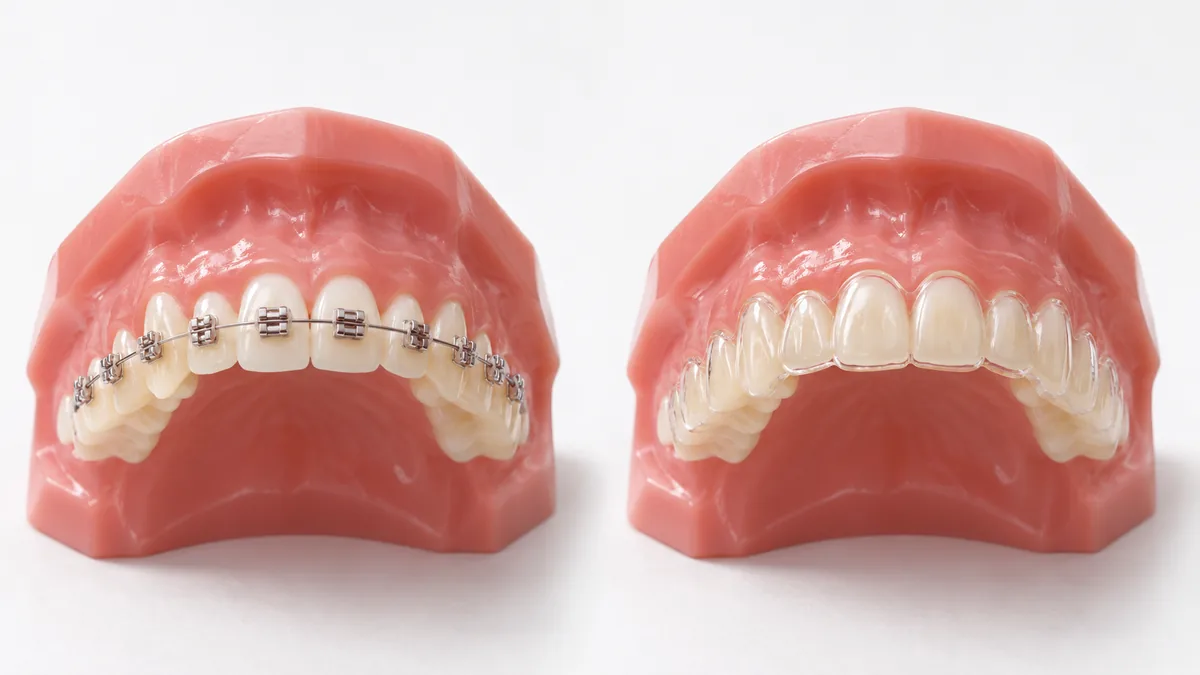
Side by side
| Feature | Braces | Clear aligners |
|---|---|---|
| What you do every day | Brush well after meals; avoid the breakage foods; wear elastics if prescribed | Keep trays in 20-plus hours; remove to eat and drink anything but water; brush before reinserting; change trays on schedule; wear elastics if prescribed |
| If you forget or slip | The wire keeps working; skipped elastics and broken brackets still add time | Teeth stop tracking; trays fit worse; time and refinements are added |
| Food | Hard, sticky and bite-into foods are out for the duration | No restrictions, but every snack means trays out and a brush or rinse |
| Cleaning | Four minutes, brackets and gum line, floss threaders or a water flosser | Normal brushing plus cleaning the trays; easier than braces |
| Appearance | Visible; ceramic is subtler; colours for those who like them | Nearly invisible; small attachments visible up close |
| Comfort | Sore teeth for a few days after each adjustment; cheeks rubbed for the first weeks | Tight for a day or two per tray; occasional rough edge; no cheek rubbing |
| Speech | Slight lisp for a few days | Slight lisp for a few days with each new set; some people notice it longer |
| Sport | Orthodontic mouthguard essential | Trays out, with a standard mouthguard |
| Music (wind and brass) | Two to four weeks to adapt; wax helps | Usually easy; some remove trays to play |
| Appointments | Every 6 to 10 weeks, 15 to 30 minutes | Every 8 to 12 weeks; some clinics use remote monitoring |
| Emergencies | Poking wire, loose bracket: a few per treatment | Lost or cracked tray; a sharp edge |
| What it handles best | Everything, including rotations, bodily movement, extraction spaces, impacted teeth, large bite corrections | Crowding, spacing, mild-to-moderate bite problems, open bites, relapse cases |
| What it handles less well | Hygiene demands, cheek and lip irritation, food rules; some movements (such as intruding back teeth) are slower | Rotating round teeth, moving teeth bodily over distance, extruding teeth, some large corrections |
| Treatment time | 12 to 30 months | 6 to 24 months plus refinements; longer if wear slips |
| Cost | Varies with complexity; metal is usually the baseline | Often similar to or higher than braces for comparable cases; the lab fee is a factor |
| Retention afterwards | Same for both: retainers on the schedule your orthodontist sets, reduced over the years but never stopped | Same for both: retainers on the schedule your orthodontist sets, reduced over the years but never stopped |
How the decision is actually made
Orthodontists decide in two steps, and the order matters.
- What movements does this case need? If the plan needs a canine moved bodily into an extraction space, or a severely rotated premolar, or a large Class II correction in an adult, braces are the more predictable tool, and an honest plan says so even if you walked in asking for aligners. If the plan is crowding, spacing, mild bite correction or relapse, either tool works.
- Who is the patient? Given that either would work, the choice comes down to whether the person will wear a removable appliance 20-plus hours a day for a year or more. Adults usually will. Teenagers vary, and the honest answer usually comes from the family rather than from the clinic. A frank conversation at home before the consultation saves months.
Hybrid plans are common: a period of braces for the hard movements, then aligners to finish; or aligners with a few brackets on specific teeth. Ask whether that is on the table.
Three honest scenarios
| Scenario | Likely direction | Why |
|---|---|---|
| Adult, teeth shifted since teenage braces, mild crowding of the front teeth | Aligners | Predictable movements, high compliance, discretion matters at work |
| 13-year-old, moderate crowding, upper teeth well ahead of lower, plays hockey | Braces, or Invisalign Teen with mandibular advancement if compliance is confident | Bite correction during growth; a mouthguard is needed either way; compliance is the deciding question |
| Adult, one tooth blocked out of the arch, extraction planned | Braces, possibly finishing with aligners | Closing an extraction space and bringing a blocked-out tooth in bodily is more reliable with a fixed appliance |
Why this matters clinically
Aligners exert force only while seated, so the biology of tooth movement is interrupted every time they are out. Aligners only apply force while seated; clinical practice sets the daily threshold at 20 or more hours, and below it teeth fall behind the trays. Braces apply force continuously, which is why they are indifferent to the wearer's habits and why they remain the reference appliance for complex cases. Neither is faster in any general, evidence-supported sense; the case and the wearer set the pace.
What this guide does not cover
Which provider to choose, how to compare two quotes, and how to read an Invisalign provider designation are questions about providers, not treatment. SurreyOrthodontist.com covers them.
Questions people ask
Is Invisalign faster than braces?
No, not in general. Simple cases are quick with either; complex cases take as long as the biology needs. Aligner treatment gets longer, not shorter, when wear time slips.
Is Invisalign less painful?
Most people find aligner pressure milder than braces adjustments and appreciate the absence of cheek rubbing. Both cause tender teeth for a day or two at each change.
Can I switch from braces to Invisalign partway?
Often yes, once the hard movements are done. Ask at the start whether a hybrid plan suits your case; it is usually cheaper to plan than to add.
Do I still need retainers with Invisalign?
Yes, and the schedule is set for the patient rather than being the same for everyone. Some wear retainers full-time for a period and then move to night-time wear; some go straight to night-time wear. From there the frequency is gradually reduced over the years — but never stopped, because teeth drift for life. Retention.
References
- Papadimitriou A, Mousoulea S, Gkantidis N, Kloukos D. Clinical effectiveness of Invisalign orthodontic treatment: a systematic review. Progress in Orthodontics 2018;19:37. https://doi.org/10.1186/s40510-018-0235-z
- Kravitz ND, Kusnoto B, BeGole E, Obrez A, Agran B. How well does Invisalign work? A prospective clinical study evaluating the efficacy of tooth movement with Invisalign. American Journal of Orthodontics and Dentofacial Orthopedics 2009;135(1):27-35. https://doi.org/10.1016/j.ajodo.2007.05.018
- Proffit WR, Fields HW, Larson BE, Sarver DM. Contemporary Orthodontics, 6th edition. Elsevier, 2019.
- Monk AB, Harrison JE, Worthington HV, Teague A. Pharmacological interventions for pain relief during orthodontic treatment. Cochrane Database of Systematic Reviews 2017;(11):CD003976. https://doi.org/10.1002/14651858.CD003976.pub2
Where Surrey families get this treatment
Guildford Orthodontic Centre
A specialist orthodontic practice in Guildford where Dr. Aly Kanani and Dr. Aida Mesbahi, both Certified Specialists in Orthodontics, provide braces, Invisalign and growth-appliance treatment for children, teens and adults.
The complimentary first visit includes an examination, photographs and a digital scan, with radiographs when indicated, and ends with a written plan and quote. Braces adjustments, aligner checks, emergency visits and retainer follow-up all happen at the same Guildford office.
- Address
- Suite 200 – 10203 152A Street, Surrey, BC V3R 4H6 (Guildford)
- Hours
- Monday to Saturday, 8 am to 5 pm
- Website
- guildfordorthodontics.com
Disclosure: SurreyBraces.com is a treatment guide published by the myORTHODONTIST network, which operates Guildford Orthodontic Centre. The guidance above applies whoever provides your care. Full disclosure.
About this guide
- Published by
- The myORTHODONTIST network
- Written by
- SurreyBraces.com editorial team
- Clinical reviewer
- Dr. Aly Kanani, Certified Specialist in Orthodontics (profile). Review assigned; sign-off date will be shown here once complete.
- First published
- 20 September 2026