Quick answer
Metal and ceramic braces move teeth the same way and take the same time. Ceramic brackets are tooth-coloured and much less noticeable in person and in photographs, slightly larger, more brittle, and their clear ties stain with coffee, tea, curry and smoking between visits. Because ceramic is harder than enamel, lower ceramic brackets can wear the upper front teeth that bite on them, so many orthodontists use ceramic on the upper arch and metal on the lower. Ceramic usually costs more. Adults and older teens who want discretion choose ceramic; most teens choose metal.
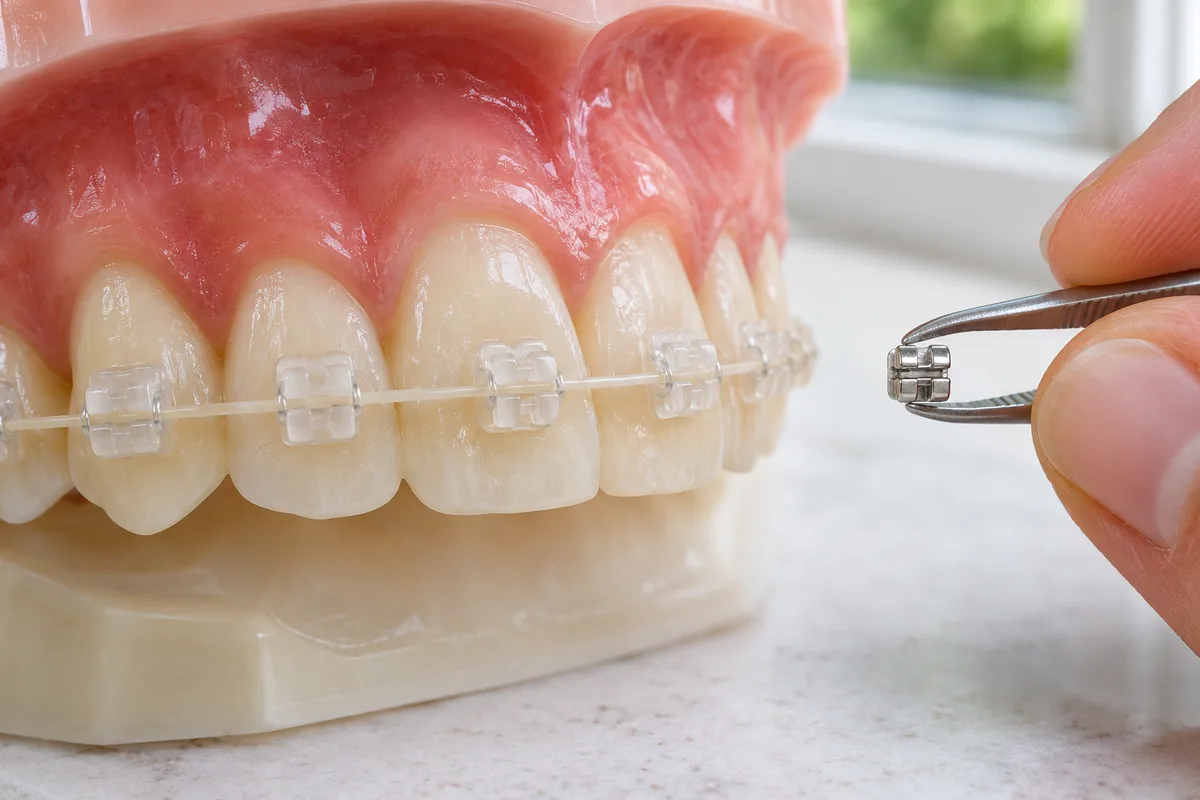
The comparison
| Feature | Metal | Ceramic |
|---|---|---|
| Visibility | Visible at any distance | Hard to see at conversation distance; the wire remains visible unless coated |
| Size and feel | Smallest, lowest profile | Slightly larger; lips adapt within a week or two |
| Ties | Coloured or grey elastic ties, replaced each visit | Clear or white ties; yellow between visits with strong-coloured food and drink |
| Strength | Very durable | Brittle; brackets can chip or fracture on hard food or during removal |
| Wear on opposing teeth | Metal is softer than enamel; no wear | Ceramic is harder than enamel; lower ceramic brackets can wear the upper front teeth that bite against them |
| Friction and treatment time | Baseline | Slightly higher friction in older designs; no meaningful difference in overall treatment time in trials |
| Debond | Simple | Takes a little longer; brackets are removed carefully to avoid fracture |
| Cost | Baseline | Usually a higher fee; the recommended clinic itemizes this in the written quote |
| Best for | Anyone; most teens; complex cases | Adults and older teens who want discretion; often upper arch only |
The staining question, honestly
Ceramic brackets themselves do not stain. The clear elastic ties that hold the wire do, and so does the plaque that collects around any bracket. Between visits, coffee, tea, red wine, turmeric and tomato-based sauces turn clear ties yellowish; smoking turns them brown. The ties are replaced at every adjustment, so the effect resets every 6 to 10 weeks. If staining would bother you, self-ligating ceramic brackets (which use a clip instead of ties) avoid it. The braces hub compares all three types.
Why many plans mix metal and ceramic
The upper front teeth are what people see when you smile; the lower teeth are mostly hidden by the lip. Ceramic on top and metal on the bottom gets most of the appearance benefit, avoids the wear problem on the upper front teeth, and costs less than ceramic throughout. It is a common recommendation and worth asking about.
Living with ceramic
- The food rules are the same as metal, and slightly more important: ceramic brackets fracture on the foods that would merely loosen a metal one.
- Rinse after coffee, tea and curry; brush after meals. It keeps the ties clearer and the enamel around the brackets healthy.
- A whitening toothpaste will not whiten under a bracket. Save whitening for after debond.
- Expect the debond visit to take a little longer.
Why this matters clinically
Trials comparing bracket materials and ligation systems have not shown clinically meaningful differences in treatment time or discomfort. The material decision is therefore a preference decision, made on appearance, cost and the wear consideration, and a good consultation presents it that way rather than as a performance upgrade.
Questions people ask
Do ceramic braces take longer than metal?
Not meaningfully. Older ceramic designs had higher friction, but studies have not found a clinically important difference in overall treatment time.
Can I have ceramic braces on my lower teeth?
Yes, but many orthodontists prefer metal on the lower arch to avoid wear on the upper front teeth that bite against lower brackets, and because the lower teeth are less visible. Ask what suits your bite.
Are ceramic braces the same as clear aligners?
No. Ceramic braces are fixed brackets and wires that happen to be tooth-coloured. Aligners are removable trays. Braces versus Invisalign.
References
- Proffit WR, Fields HW, Larson BE, Sarver DM. Contemporary Orthodontics, 6th edition. Elsevier, 2019.
Where Surrey families get this treatment
Guildford Orthodontic Centre
A specialist orthodontic practice in Guildford where Dr. Aly Kanani and Dr. Aida Mesbahi, both Certified Specialists in Orthodontics, provide braces, Invisalign and growth-appliance treatment for children, teens and adults.
The complimentary first visit includes an examination, photographs and a digital scan, with radiographs when indicated, and ends with a written plan and quote. Braces adjustments, aligner checks, emergency visits and retainer follow-up all happen at the same Guildford office.
- Address
- Suite 200 – 10203 152A Street, Surrey, BC V3R 4H6 (Guildford)
- Hours
- Monday to Saturday, 8 am to 5 pm
- Website
- guildfordorthodontics.com
Disclosure: SurreyBraces.com is a treatment guide published by the myORTHODONTIST network, which operates Guildford Orthodontic Centre. The guidance above applies whoever provides your care. Full disclosure.
About this guide
- Published by
- The myORTHODONTIST network
- Written by
- SurreyBraces.com editorial team
- Clinical reviewer
- Dr. Aida Mesbahi, Certified Specialist in Orthodontics (profile). Review assigned; sign-off date will be shown here once complete.
- First published
- 20 September 2026