Quick answer
A palatal expander is fixed to the upper back teeth and widened by a parent turning a small key. The turning schedule is customised to the patient rather than being the same for everyone, and the appliance is then left in place to let new bone fill in. A gap between the front teeth opens and closes again; speech and swallowing take a few days to adjust. Twin blocks and similar functional appliances are removable plastic blocks that hold the lower jaw forward and are worn most of the day and night for 9 to 12 months during the growth spurt. Neither is usually painful, though both cause pressure and tired muscles at first.
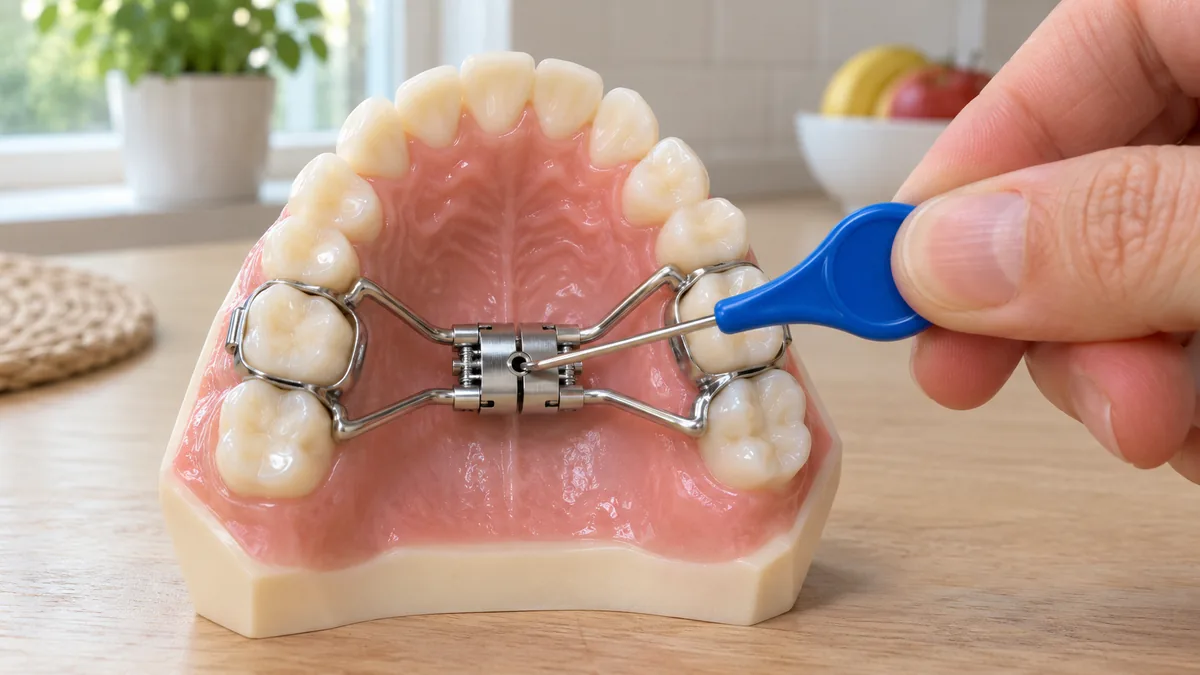
Palatal expanders
The upper jaw is two halves joined at a midline suture that usually fuses during the mid-to-late teens, though the timing varies from person to person. An expander, cemented to the upper back teeth, pushes the halves apart a fraction of a millimetre per turn; the body fills the space with new bone. It is used for a narrow upper jaw with a posterior crossbite, and sometimes to make room for crowded teeth or for an upper canine that is heading the wrong way.
- Fitting (30 to 45 minutes)Separators may be placed a week before to make room around the molars. The expander is cemented in; the mouth feels full and the tongue explores it constantly for days.
- Days 1 to 5Speech is thick, swallowing feels odd, saliva increases. Soft food. Practise reading aloud; it speeds the adjustment.
- Turning phaseA parent inserts the key into the hole in the screw, pushes it toward the back of the mouth until the next hole appears, and removes it. How often, and for how many weeks, is set for your child specifically and given to you in writing — it is not the same for everyone. The child feels pressure across the nose and cheeks for a minute or two. A gap often appears between the front teeth within a week or two: this is the suture opening and is a sign the expander is working.
- Holding phaseNo more turns. The appliance stays in while new bone forms across the widened suture. The front gap closes on its own as the teeth drift together. Braces or aligners may start during this time.
- Removal (15 minutes)The cement is cracked and the expander lifted off. The palate feels enormous for a day. A retainer with a plate, or the next appliance, holds the width.
Twin blocks and other functional appliances
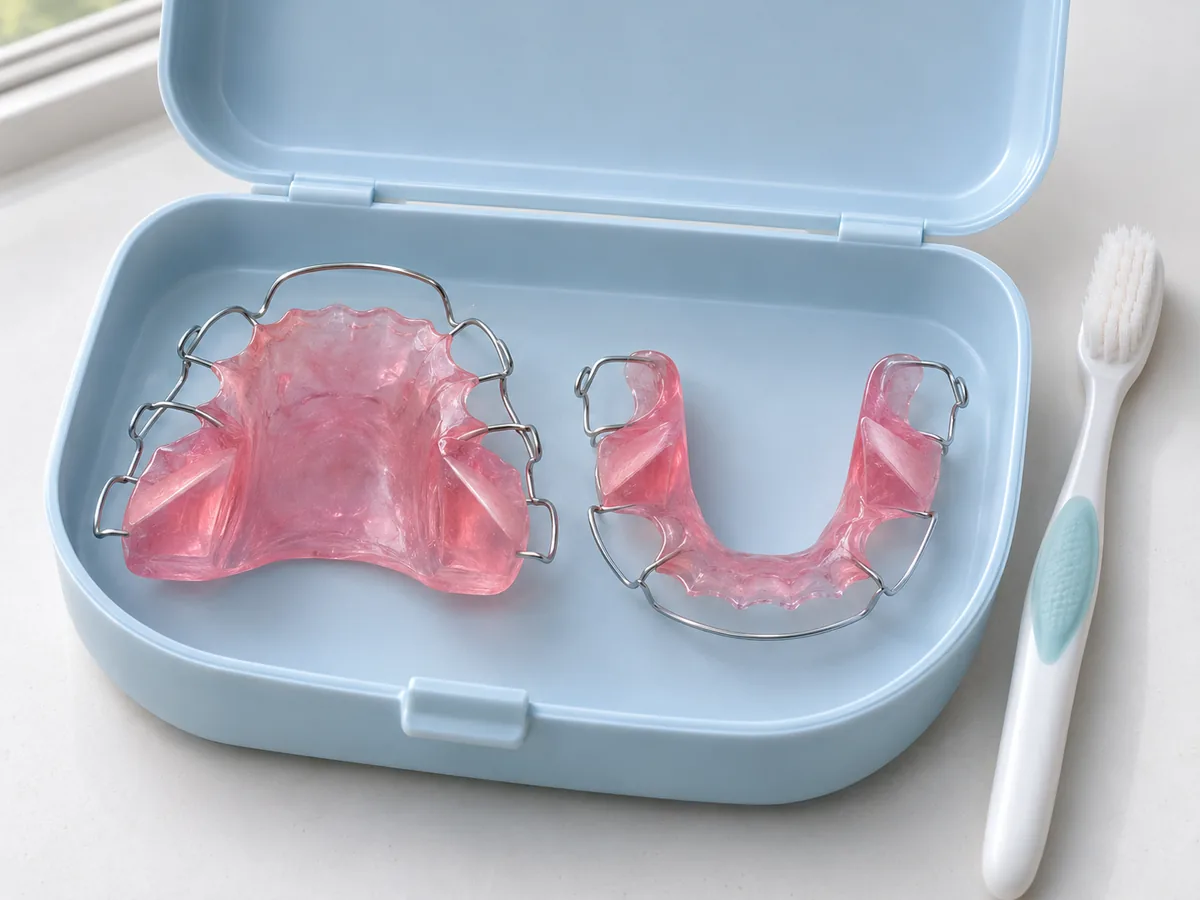
For a lower jaw that sits well behind the upper (the most common reason for prominent front teeth), a functional appliance holds the lower jaw forward while the child grows, encouraging the bite to correct. Twin blocks are the common removable version: two plastic plates with angled blocks that meet only when the jaw is forward. Fixed versions exist, as does a mandibular advancement feature built into some aligners.
- Wear: most of the day and all night, out for eating (sometimes worn while eating, on instruction), for 9 to 12 months. Growth-spurt timing matters, so the orthodontist may wait for it.
- First two weeks: tired jaw muscles, a lot of saliva, speech that improves with practice. The bite feels wrong when the appliance is out; that is expected.
- Cleaning: brush the appliance with a soft brush and cool water after meals; soak weekly. Keep it in its case, never in a napkin.
- Compliance: the appliance only works while it is in. Missed days show at the next visit as no change.
- What follows: usually a period of braces or aligners to align the teeth once the jaws fit better.
What growth appliances can and cannot do
| Claim | What the evidence supports |
|---|---|
| Expansion corrects a posterior crossbite in a growing child | Well supported; one of the best-established early treatments |
| Expansion makes room for crowded teeth | Partly; it gains a few millimetres, which resolves mild crowding and reduces moderate crowding |
| Functional appliances correct a Class II bite | Supported in growing patients; the change is mostly in the teeth and bite, with a small skeletal effect; results after full treatment are similar whether treatment is one-phase or two-phase |
| Early treatment reduces the chance of injury to prominent front teeth | Supported by systematic review |
| Early treatment avoids extractions or surgery later | Sometimes, in specific cases; not a general promise |
| Expansion treats breathing or sleep problems | Not an orthodontic outcome to promise. Some studies report changes in nasal dimensions after expansion; whether that improves breathing or sleep in a given child is a medical question for a physician |
A note on airway and sleep. Orthodontists assess growth, jaws, bite, arches and habits. Physicians diagnose medical sleep and airway disorders, and orthodontic treatment is not a treatment for sleep apnea, snoring, mouth breathing or attention difficulties. Where a growth pattern or habit may be relevant to breathing, a good assessment says so and suggests a medical referral rather than promising an outcome. For the national evidence summary, see AirwayOrthodontics.ca.
Why this matters clinically
The midline suture of the upper jaw responds to expansion only while it is open, which is why expansion is a childhood and early-teen treatment. Functional appliances depend on the growth spurt to have an effect. Timing and compliance, more than appliance choice, are the variables that most affect whether a growth appliance works, which is why an orthodontist may ask a family to wait a year rather than start now.
Questions people ask
Does turning the expander hurt?
Usually it causes pressure across the nose and cheeks for a minute or two rather than pain; some children find the first turns sore. If a turn causes sharp pain or the key will not go in, stop and call.
The gap between the front teeth is huge. Is that normal?
Yes. It is the sign the suture is opening. It closes on its own during the holding phase.
What if we miss a turn?
Do not double up. Do the next scheduled turn and tell the clinic at the next visit; the schedule can be extended.
Can adults have an expander?
Once the suture has matured, conventional expansion mostly tips the teeth rather than widening the jaw. Adults who need true skeletal width may be offered mini-screw-assisted expansion or surgically assisted expansion, depending on the case.
References
- Agostino P, Ugolini A, Signori A, Silvestrini-Biavati A, Harrison JE, Riley P. Orthodontic treatment for posterior crossbites. Cochrane Database of Systematic Reviews 2014;(8):CD000979. https://doi.org/10.1002/14651858.CD000979.pub2
- Batista KBSL, Thiruvenkatachari B, Harrison JE, O'Brien KD. Orthodontic treatment for prominent upper front teeth (Class II malocclusion) in children and adolescents. Cochrane Database of Systematic Reviews 2018;(3):CD003452. https://doi.org/10.1002/14651858.CD003452.pub4
- Thiruvenkatachari B, Harrison J, Worthington H, O'Brien K. Early orthodontic treatment for Class II malocclusion reduces the chance of incisal trauma: Results of a Cochrane systematic review. American Journal of Orthodontics and Dentofacial Orthopedics 2015;148(1):47-59. https://doi.org/10.1016/j.ajodo.2015.01.030
- Behrents RG, Shelgikar AV, Conley RS, et al. Obstructive sleep apnea and orthodontics: An American Association of Orthodontists White Paper. American Journal of Orthodontics and Dentofacial Orthopedics 2019;156(1):13-28.e1. https://doi.org/10.1016/j.ajodo.2019.04.009
- Proffit WR, Fields HW, Larson BE, Sarver DM. Contemporary Orthodontics, 6th edition. Elsevier, 2019.
Where Surrey families get this treatment
Guildford Orthodontic Centre
A specialist orthodontic practice in Guildford where Dr. Aly Kanani and Dr. Aida Mesbahi, both Certified Specialists in Orthodontics, provide braces, Invisalign and growth-appliance treatment for children, teens and adults.
The complimentary first visit includes an examination, photographs and a digital scan, with radiographs when indicated, and ends with a written plan and quote. Braces adjustments, aligner checks, emergency visits and retainer follow-up all happen at the same Guildford office.
- Address
- Suite 200 – 10203 152A Street, Surrey, BC V3R 4H6 (Guildford)
- Hours
- Monday to Saturday, 8 am to 5 pm
- Website
- guildfordorthodontics.com
Disclosure: SurreyBraces.com is a treatment guide published by the myORTHODONTIST network, which operates Guildford Orthodontic Centre. The guidance above applies whoever provides your care. Full disclosure.
About this guide
- Published by
- The myORTHODONTIST network
- Written by
- SurreyBraces.com editorial team
- Clinical reviewer
- Dr. Aly Kanani, Certified Specialist in Orthodontics (profile). Review assigned; sign-off date will be shown here once complete.
- First published
- 20 September 2026