Quick answer
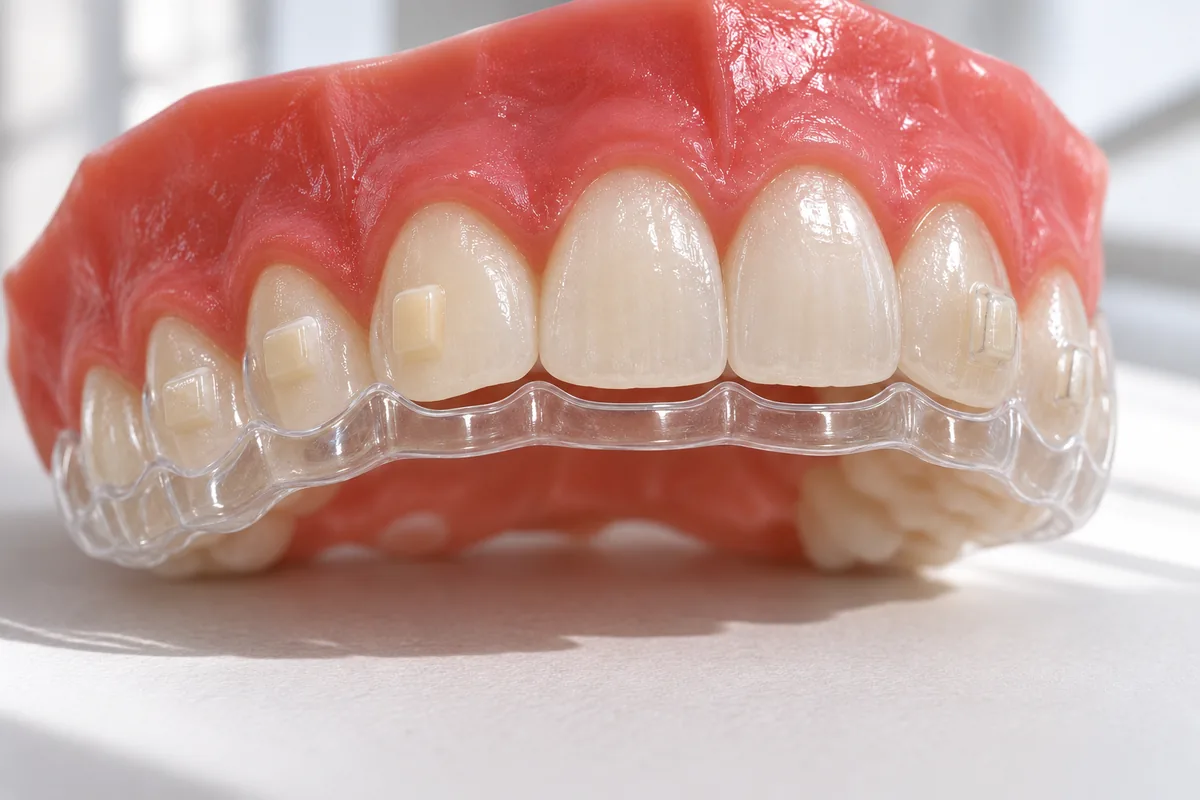
Invisalign treatment is a sequence of clear plastic aligners, each worn 20 or more hours a day and swapped for the next on a schedule your orthodontist sets (often weekly). Small tooth-coloured attachments bonded to some teeth give the trays grip. Aligners come out for eating and for anything but water, and go back in after brushing. Treatment usually takes 6 to 24 months, often with one or two rounds of refinement trays at the end, and is followed by retainers worn on the schedule your orthodontist sets, reduced over the years but never stopped.
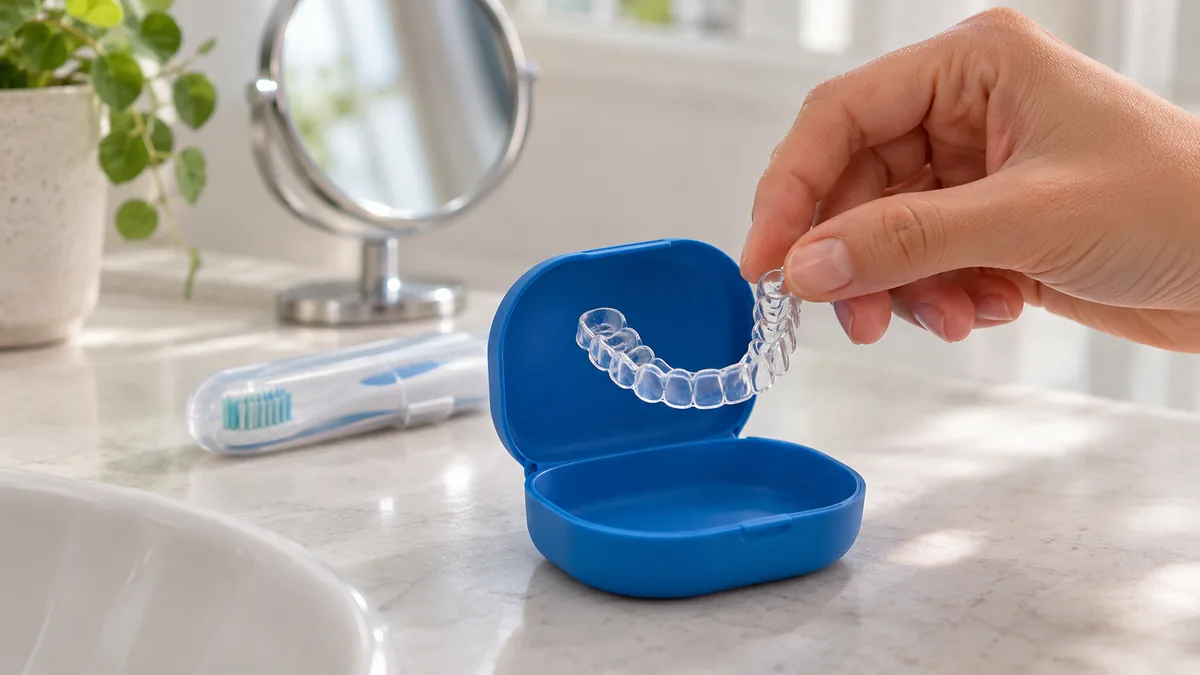
The daily routine
- Aligners in overnight, out for breakfast, brush, back in. Coffee or tea means trays out, then rinse before they go back.
- Out for lunch, brush or at least rinse thoroughly, back in. A travel brush and the case live in your bag.
- Out for dinner, brush and floss, clean the aligners with a soft brush and cool water (not hot), back in for the night.
- Track hours. Twenty or more out of twenty-four is the standard; less, and teeth lag behind the trays.
- Elastics, if prescribed, hook onto small cut-outs or buttons and are worn with the aligners in.
- Chewies (small foam cylinders) for a few minutes after inserting a new tray help seat it fully.
The hardware, explained
- Aligners. Each tray is made to move teeth a small distance from the previous one. New trays feel tight for a day or two; that pressure is the treatment. A tray that stays loose after a week usually means wear time has slipped.
- Attachments. Small tooth-coloured composite shapes bonded to selected teeth so the tray can grip and push in the right direction. Most patients have several. They are placed at the first visit and polished off at the end. Attachments in detail.
- Interproximal reduction (IPR). Light polishing between some teeth, a fraction of a millimetre, to create space for crowding. It is usually not uncomfortable, is done with a fine strip or disc, and is planned in advance.
- Elastics, buttons and cut-outs. Used for bite correction, exactly as with braces.
- Refinements. Teeth do not always track the plan perfectly. A new scan and a short additional series of trays finishes the details. One or two refinement rounds are normal, not a failure.
What aligners do well, and where they are harder
| Movement | How aligners manage | Notes |
|---|---|---|
| Mild to moderate crowding | Well | Often with IPR or slight arch widening. Crowding guide. |
| Spacing and gaps | Well | Closed spaces need firm retention afterwards. Gaps guide. |
| Tipping teeth in or out | Well | A natural aligner movement. |
| Rotating rounded teeth (canines, premolars) | Harder | Attachments help; sometimes over-corrected in the plan or finished with braces. |
| Moving teeth bodily (root and crown together) | Harder | Predictability is lower; large extraction-space closures are more reliably done with braces. |
| Extruding a tooth (pulling it down) | Demanding to plan | Older accuracy studies found extrusion among the least predictable aligner movements; optimised attachment designs have improved it since, though it still needs careful planning. |
| Anterior open bite | Often well | Aligners intrude back teeth, which can help close a front open bite. Open bite guide. |
| Dental crossbite of one or two teeth | Well | Skeletal crossbites need expansion, especially in adults. Crossbite guide. |
| Large bite corrections (Class II, Class III) | Variable | Elastics or a mandibular-advancement version help growing teens; adults may need a hybrid plan or surgery. |
Studies of aligner accuracy consistently find that some planned movements are achieved less fully than others, which is why refinements exist and why an honest plan mentions them at the start.
Who it is for
Guildford Orthodontic Centre provides Invisalign for adults, Invisalign Teen, Invisalign First for children in the mixed dentition, and the mandibular advancement feature for suitable growing patients. Whether aligners suit a particular case is a clinical decision made at the assessment; a general dentist or orthodontist can both provide aligner treatment in BC, and the choice of provider is covered on SurreyOrthodontist.com.
Things that go wrong, and what to do
- Lost or cracked aligner. Put the previous tray in (or the next, if the orthodontist agrees) so teeth do not drift, and call. Wear time and lost aligners.
- A sharp edge. A clean emery board smooths it. Wax works on aligners too.
- Cloudy or smelly trays. Brush them with cool water and a soft brush; avoid toothpaste (it scratches) and hot water (it warps them). Cleaning crystals are optional.
- Trays not fitting after a lapse. Do not force a later tray. Go back to the last one that fits and call; a new scan may be needed.
A note on airway and sleep. Orthodontists assess growth, jaws, bite, arches and habits. Physicians diagnose medical sleep and airway disorders, and orthodontic treatment is not a treatment for sleep apnea, snoring, mouth breathing or attention difficulties. Where a growth pattern or habit may be relevant to breathing, a good assessment says so and suggests a medical referral rather than promising an outcome. For the national evidence summary, see AirwayOrthodontics.ca.
Why this matters clinically
Aligners move teeth by the same bone remodelling as braces, but the force is delivered by plastic that only works while it is on the teeth. Below the 20-or-more-hours-a-day threshold used in clinical practice, the tooth stops tracking the tray and each subsequent tray fits worse. This is the practical reason the wear-time rule is strict and why the recommended clinic treats 20 hours as the minimum, not the target.
Questions people ask
Does Invisalign hurt?
New trays are tight and teeth ache for a day or two, less than with braces adjustments for most people. Attachments and IPR are usually not uncomfortable. Edges can rub at first.
Can I drink coffee with aligners in?
No. Hot drinks warp the plastic and coloured drinks stain it, and anything sugary pools against the teeth under the tray. Trays out, drink, rinse, trays in.
How often do I change trays?
On the schedule your orthodontist sets. Weekly changes are common; some plans use longer intervals for particular movements. The old "two weeks for everyone" rule no longer applies.
What happens after the last tray?
A check that the plan has been achieved, often a refinement scan, then attachments are polished off and retainers are made. At Guildford Orthodontic Centre, Vivera retainers are the standard. Retention.
References
- Papadimitriou A, Mousoulea S, Gkantidis N, Kloukos D. Clinical effectiveness of Invisalign orthodontic treatment: a systematic review. Progress in Orthodontics 2018;19:37. https://doi.org/10.1186/s40510-018-0235-z
- Kravitz ND, Kusnoto B, BeGole E, Obrez A, Agran B. How well does Invisalign work? A prospective clinical study evaluating the efficacy of tooth movement with Invisalign. American Journal of Orthodontics and Dentofacial Orthopedics 2009;135(1):27-35. https://doi.org/10.1016/j.ajodo.2007.05.018
- Behrents RG, Shelgikar AV, Conley RS, et al. Obstructive sleep apnea and orthodontics: An American Association of Orthodontists White Paper. American Journal of Orthodontics and Dentofacial Orthopedics 2019;156(1):13-28.e1. https://doi.org/10.1016/j.ajodo.2019.04.009
- Littlewood SJ, Millett DT, Doubleday B, Bearn DR, Worthington HV. Retention procedures for stabilising tooth position after treatment with orthodontic braces. Cochrane Database of Systematic Reviews 2016;(1):CD002283. https://doi.org/10.1002/14651858.CD002283.pub4
Where Surrey families get this treatment
Guildford Orthodontic Centre
A specialist orthodontic practice in Guildford where Dr. Aly Kanani and Dr. Aida Mesbahi, both Certified Specialists in Orthodontics, provide braces, Invisalign and growth-appliance treatment for children, teens and adults.
The complimentary first visit includes an examination, photographs and a digital scan, with radiographs when indicated, and ends with a written plan and quote. Braces adjustments, aligner checks, emergency visits and retainer follow-up all happen at the same Guildford office.
- Address
- Suite 200 – 10203 152A Street, Surrey, BC V3R 4H6 (Guildford)
- Hours
- Monday to Saturday, 8 am to 5 pm
- Website
- guildfordorthodontics.com
Disclosure: SurreyBraces.com is a treatment guide published by the myORTHODONTIST network, which operates Guildford Orthodontic Centre. The guidance above applies whoever provides your care. Full disclosure.
About this guide
- Published by
- The myORTHODONTIST network
- Written by
- SurreyBraces.com editorial team
- Clinical reviewer
- Dr. Aly Kanani, Certified Specialist in Orthodontics (profile). Clinically reviewed on 21 September 2026.
- Originally published
- 9 May 2021
- Revised
- 20 September 2026. This address held both a page and a short post titled "Invisalign" (first published 9 May 2021). The two were merged into this single guide; the post's publication date is retained here and its original text is held in the migration record. A claim that Invisalign treats sleep apnea and airway issues was removed.