Quick answer
Poking wire: dry it, press wax over the end, or push it flat with a clean pencil eraser; call for a trim within a few days. Wire slid out of the back bracket: try to thread it back with clean tweezers, or wax it; call. Loose bracket: leave it on the wire, wax any sharp part, avoid hard food, book a repair this week. Lost bracket: keep it, book a repair. Loose band: call this week; food traps under it. None of these is an emergency room matter; a wire embedded in the cheek that cannot be freed is the one to call about the same day.
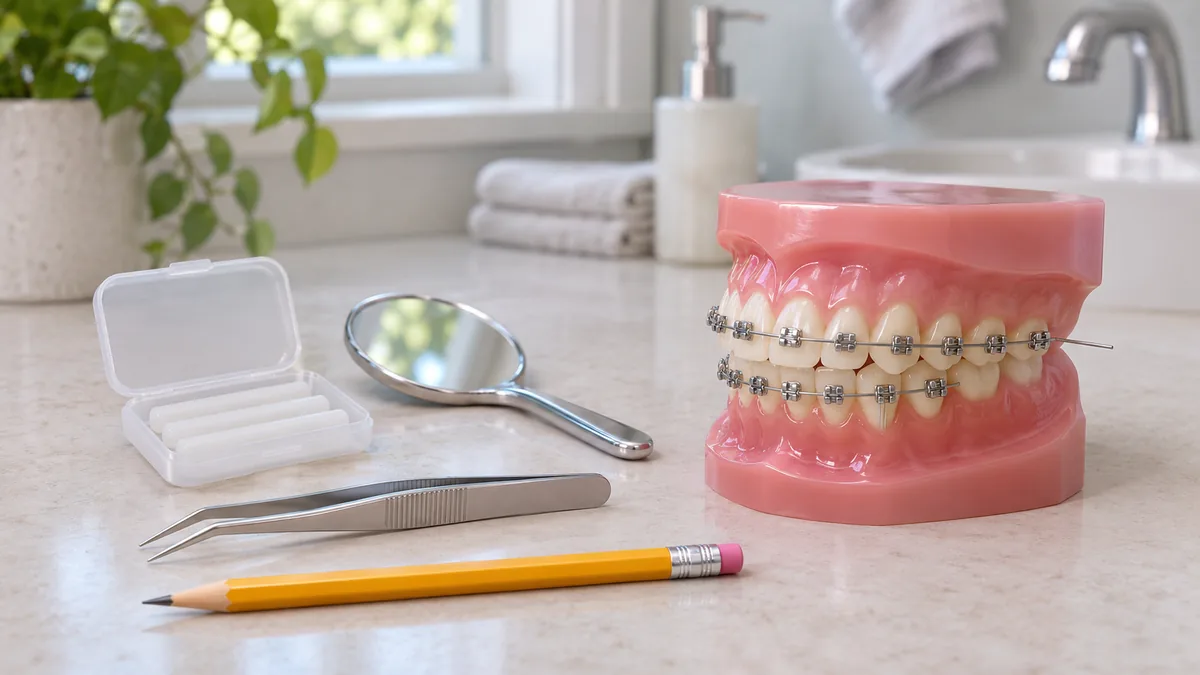
Find your problem
None of what follows is an emergency in the medical sense, and none of it needs a dash to the clinic. Make it comfortable using the steps below, then call us and we will confirm whether it needs a visit and when.
- A wire end is poking the cheek or gum at the back
- It is the tail of the main wire, sticking out behind the last bracket: Dry the area with a tissue. Press a pea-sized piece of wax over the end. Or use a clean pencil eraser to push the end flat against the tooth. Book a trim (5 minutes) in the next few days. Eat on the other side.
- It is a thin ligature wire (a fine twisted wire holding a bracket): Push it flat with the eraser or a clean cotton swab, then wax. Not urgent; mention it at the next visit or call if it keeps catching.
- It has gone into the cheek and will not come free: Call us and we will confirm the next step; the clinic is open Monday to Saturday, 8 am to 5 pm. If nobody is reachable and the wire is cutting into the cheek, a long end can be clipped as a last resort: a clean nail clipper, good light and a mirror, a folded tissue held behind the wire so the cut piece is caught rather than swallowed, cutting as close to the last bracket as you can reach. Wax the cut end and call the clinic the next working day.
- The main wire has slid to one side and is out of the last bracket on one end
- The other end is long and poking: With clean tweezers, grip the wire and try to slide it back through the last bracket or tube. If it will not go, wax the long end and call for a visit this week. This happens as teeth align and the wire "gains" length; it is expected.
- It is just short on one side, nothing poking: Not urgent; mention it at the next visit.
- A bracket is loose (spins on the wire) or has come off entirely
- Loose but still on the wire: Leave it. Wax anything sharp. Avoid hard food. Book a rebond (15 to 20 minutes) this week; the tooth simply pauses until then.
- Off entirely: Keep it in a bag; the clinic may reuse it. Book a rebond. Check whether the wire end is now poking and wax it.
- It is a molar band that is loose: Call this week. Food and plaque under a loose band cause decay, and the band needs recementing.
- A coloured elastic tie has come off one bracket
- The wire is still in the bracket: Harmless. Mention it at the next visit. If the wire has slipped out of that bracket, call.
- A separator (small rubber ring between back teeth) has fallen out
- The banding appointment is within two days: Call; it may be fine or may need replacing.
- The banding appointment is more than two days away: Call to have it replaced; the space closes again quickly.
- An expander has come loose on one side
- Yes: Stop turning. Call today; a loose expander can twist and cut the tongue. Wax any sharp part.
- An aligner is cracked, lost or not fitting
- Yes: See wear time and lost aligners.
Why brackets come off
Usually food: something hard or sticky, or biting into something with the front teeth. Occasionally a bracket was bonded onto a surface that got wet at bond day and fails weeks later. Sometimes a deep bite means the lower brackets are bitten on by the upper teeth, which is why the clinic may put temporary bumps on the back teeth. One or two breakages in a treatment is normal; more than that and the food rules need revisiting, because each repair typically adds a few weeks. The food guide.
What the repair visit is like
Ten to twenty minutes. The old glue is removed, the tooth is conditioned again, the bracket is rebonded and the wire re-tied. It is usually not uncomfortable.
Why this matters clinically
A loose bracket stops force to that tooth, so the tooth stops and its neighbours may drift into the gap; a wire slid out of its back tube can rotate the last molar the wrong way. Neither causes harm over a few days, which is why these are "this week" problems. An embedded wire is the exception because soft tissue injury and infection are possible.
Questions people ask
Can I cut a poking wire myself?
Wax and an eraser handle almost all cases, and a trim at the clinic takes five minutes. As a last resort, when nobody is reachable and the wire is cutting into the cheek, a long end can be clipped with a clean nail clipper in good light, with a folded tissue held behind it to catch the piece, cutting close to the last bracket. Wax the cut end and call us the next working day.
Will a loose bracket delay my treatment?
A few days, no. A week or two before repair, slightly. Repeated breakages, yes, by weeks each.
Is a loose bracket an emergency?
No. It is a this-week repair. Wax anything sharp and eat soft food until then.
References
- American Association of Orthodontists. Handling orthodontic emergencies at home. Consumer guidance. https://aaoinfo.org/
- Proffit WR, Fields HW, Larson BE, Sarver DM. Contemporary Orthodontics, 6th edition. Elsevier, 2019.
Where Surrey families get this treatment
Guildford Orthodontic Centre
A specialist orthodontic practice in Guildford where Dr. Aly Kanani and Dr. Aida Mesbahi, both Certified Specialists in Orthodontics, provide braces, Invisalign and growth-appliance treatment for children, teens and adults.
The complimentary first visit includes an examination, photographs and a digital scan, with radiographs when indicated, and ends with a written plan and quote. Braces adjustments, aligner checks, emergency visits and retainer follow-up all happen at the same Guildford office.
- Address
- Suite 200 – 10203 152A Street, Surrey, BC V3R 4H6 (Guildford)
- Hours
- Monday to Saturday, 8 am to 5 pm
- Website
- guildfordorthodontics.com
Disclosure: SurreyBraces.com is a treatment guide published by the myORTHODONTIST network, which operates Guildford Orthodontic Centre. The guidance above applies whoever provides your care. Full disclosure.
About this guide
- Published by
- The myORTHODONTIST network
- Written by
- SurreyBraces.com editorial team
- Clinical reviewer
- Dr. Aly Kanani, Certified Specialist in Orthodontics (profile). Clinically reviewed on 21 September 2026.
- First published
- 20 September 2026