Quick answer
Teeth can be moved at any age provided the gums and bone around them are healthy. Adult treatment differs from teen treatment in three ways: there is no growth to help with jaw discrepancies, so some bite problems need compromise or surgery; movement is usually a little slower; and gum health has to be checked and managed first. Clear aligners, ceramic braces and metal braces are all used. Most adult treatment takes 6 to 24 months, and retention afterwards is indefinite.
Why adults have treatment
The most common reasons are teeth that have shifted since teenage treatment (usually because a retainer was lost or abandoned years ago), crowding that makes cleaning difficult, a bite that is wearing teeth unevenly, and preparation for other dental work such as implants or crowns that need space or an even bite. Appearance matters to most adults too, and there is nothing wrong with that being the main reason.
How adult treatment differs
| Feature | Teen | Adult |
|---|---|---|
| Growth | Jaw growth can be used to correct how the jaws fit | Growth is finished; skeletal discrepancies are camouflaged with tooth movement or corrected with jaw surgery |
| Speed | Bone remodels quickly | Bone remodels more slowly; movements take somewhat longer |
| Gums and bone | Usually healthy | Gum disease must be treated and stable before teeth are moved; recession is more common and must be planned around |
| Existing dental work | Rare | Crowns, implants and bridges change what can move and how brackets attach; implants cannot be moved at all |
| Appliance choice | Often braces | Often aligners or ceramic braces for discretion; metal braces remain the most capable tool |
| Goals | Ideal bite and alignment | Sometimes a deliberately limited plan: straighten the front teeth, make cleaning easier, prepare for a crown |
| Retention | Set for the patient; reduced over the years, never stopped | The same principle, often with a bonded retainer as well as removable ones |
What it is like day to day
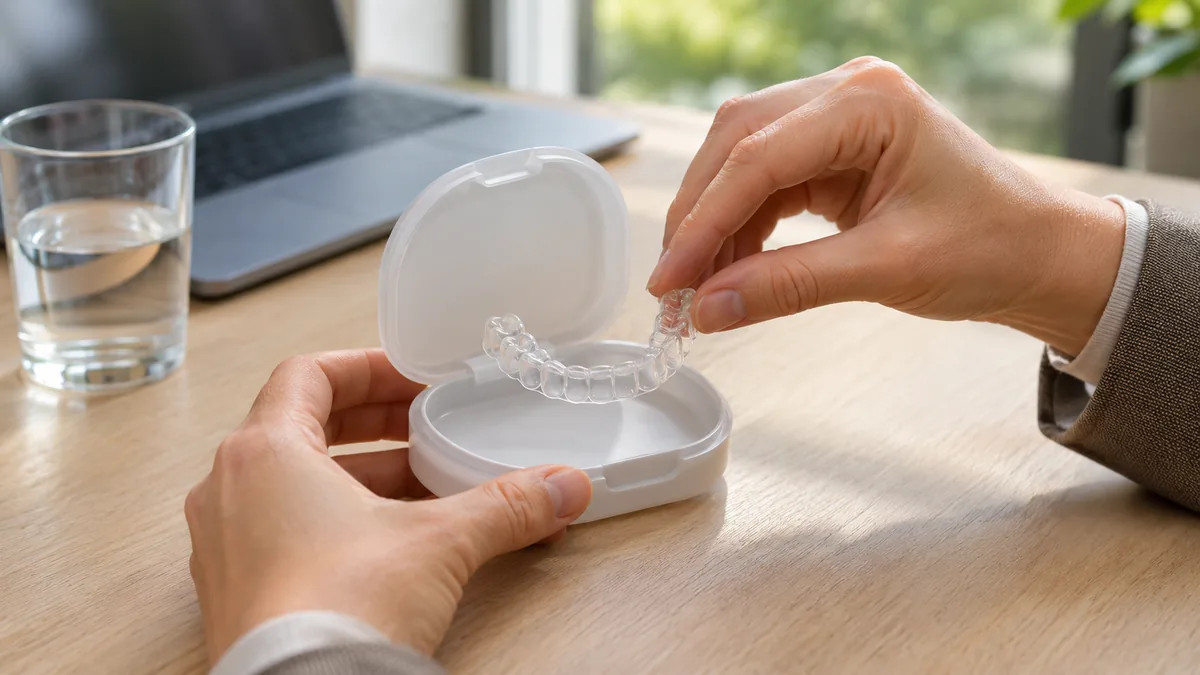
With aligners, the routine is removing them to eat, brushing before they go back in, and keeping them in for 20 or more hours a day. Coffee and tea drinkers notice this most: anything except water means trays out. With braces, the food rules and longer brushing apply exactly as they do for teenagers, and a poking wire in a meeting is a real, if rare, event. Speech with either appliance is affected for a few days, then settles. Adjustment appointments are short, every 6 to 12 weeks; the recommended clinic is open Monday to Saturday from 8 am, which makes before-work and Saturday visits possible. See braces versus Invisalign for the full comparison and the Invisalign treatment hub for aligner life in detail.
Discreet options, honestly compared
- Clear aligners are the least visible and the most convenient, and they treat a wide range of problems well. Some movements (rotating round teeth, moving teeth bodily over a distance, closing large extraction spaces) are less predictable and may need attachments, elastics or a period of braces.
- Ceramic braces are tooth-coloured brackets with the same mechanics as metal. They are less visible in person and in photographs, slightly larger than metal, and the ties can stain with coffee and curry between visits. Metal versus ceramic.
- Metal braces remain the most capable and lowest-maintenance appliance. Many adults choose them for a predictable treatment with the fewest things to manage day to day.
When the bite problem is skeletal
If the jaws themselves are mismatched (a lower jaw well behind or ahead of the upper, or a long-face open bite), an adult has two honest routes: camouflage, where teeth are moved to disguise the jaw relationship, accepting a compromise; or orthodontics combined with jaw surgery, which corrects the jaw relationship. A good consultation explains which applies and why. In BC, medically required jaw surgery performed in hospital may be covered by the Medical Services Plan while the orthodontic treatment before and after it is not; the clinic will explain the process. Deciding between these routes is a provider-choice question as much as a treatment one; SurreyOrthodontist.com covers how to evaluate a surgery recommendation.
Retreatment after earlier braces
Teeth that have relapsed after earlier treatment are often a shorter job than first-time treatment, because the bite was corrected once and the front teeth are what has moved. Aligners are well suited to this. The difference the second time is retention: removable retainers at night, for good, often with a bonded wire behind the lower front teeth where the orthodontist recommends one. Adult retreatment goes through the options.
Why this matters clinically
Adult tooth movement happens through the same biology as teenage movement, but the bone is denser and cell turnover is slower, so forces have to be gentle and time has to be allowed. Moving teeth through bone that is inflamed by untreated gum disease can accelerate bone loss, which is why a periodontal check comes before any adult treatment plan.
Questions people ask
Am I too old for braces?
No. Healthy teeth in healthy bone can be moved at any age. Patients in their sixties and seventies are treated routinely, usually to make cleaning easier or to prepare for restorative work.
Will treatment affect my work?
Rarely beyond the first week. Aligners are hard to notice; speech settles within days. Appointments are short; the recommended clinic is open Monday to Saturday, 8 am to 5 pm.
Can I have treatment if I have a crown or an implant?
Usually. Crowned teeth can be moved (brackets bond to porcelain with special preparation). Implants cannot move, so the plan works around them; sometimes orthodontics is done before an implant is placed for exactly this reason.
References
- Proffit WR, Fields HW, Larson BE, Sarver DM. Contemporary Orthodontics, 6th edition. Elsevier, 2019.
- Papadimitriou A, Mousoulea S, Gkantidis N, Kloukos D. Clinical effectiveness of Invisalign orthodontic treatment: a systematic review. Progress in Orthodontics 2018;19:37. https://doi.org/10.1186/s40510-018-0235-z
- Littlewood SJ, Millett DT, Doubleday B, Bearn DR, Worthington HV. Retention procedures for stabilising tooth position after treatment with orthodontic braces. Cochrane Database of Systematic Reviews 2016;(1):CD002283. https://doi.org/10.1002/14651858.CD002283.pub4
Where Surrey families get this treatment
Guildford Orthodontic Centre
A specialist orthodontic practice in Guildford where Dr. Aly Kanani and Dr. Aida Mesbahi, both Certified Specialists in Orthodontics, provide braces, Invisalign and growth-appliance treatment for children, teens and adults.
The complimentary first visit includes an examination, photographs and a digital scan, with radiographs when indicated, and ends with a written plan and quote. Braces adjustments, aligner checks, emergency visits and retainer follow-up all happen at the same Guildford office.
- Address
- Suite 200 – 10203 152A Street, Surrey, BC V3R 4H6 (Guildford)
- Hours
- Monday to Saturday, 8 am to 5 pm
- Website
- guildfordorthodontics.com
Disclosure: SurreyBraces.com is a treatment guide published by the myORTHODONTIST network, which operates Guildford Orthodontic Centre. The guidance above applies whoever provides your care. Full disclosure.
About this guide
- Published by
- The myORTHODONTIST network
- Written by
- SurreyBraces.com editorial team
- Clinical reviewer
- Dr. Aly Kanani, Certified Specialist in Orthodontics (profile). Review assigned; sign-off date will be shown here once complete.
- First published
- 20 September 2026