Quick answer
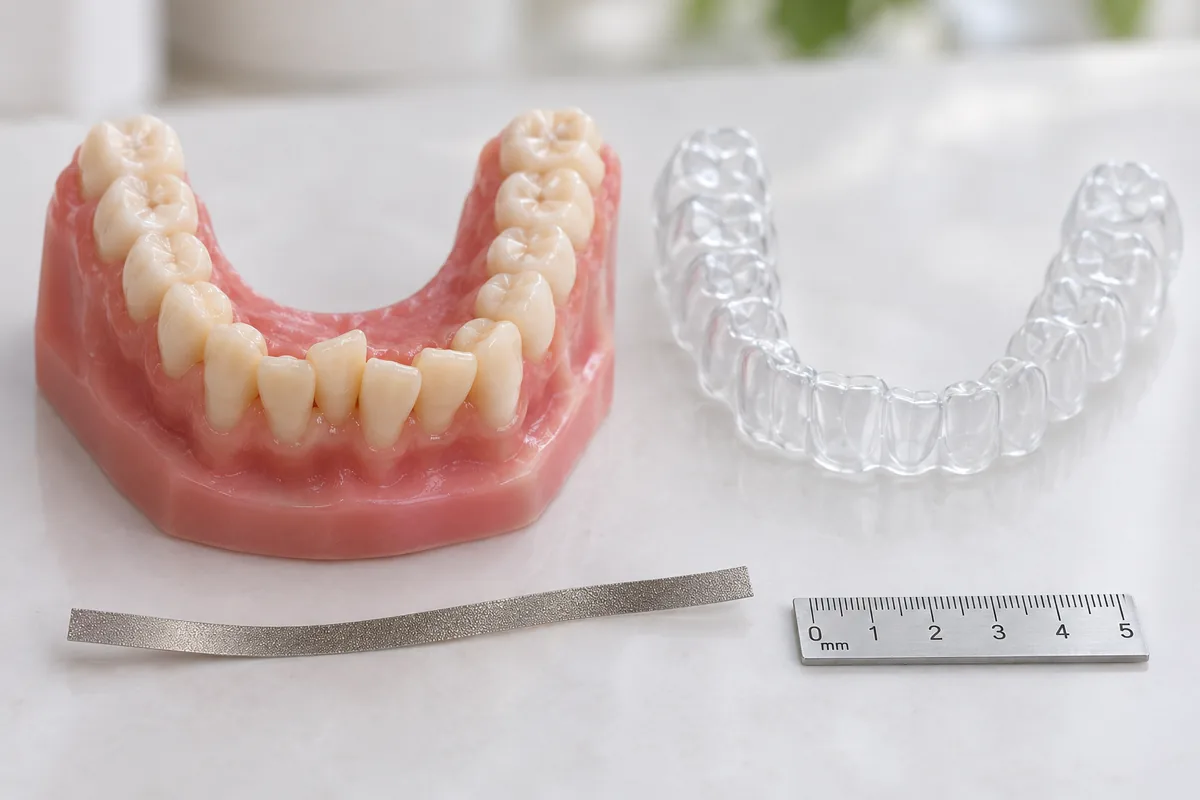
Crowding means the teeth need more room than the arch has. Aligners create that room in four ways: polishing a fraction of a millimetre from between teeth (IPR), widening the arch slightly, tipping the front teeth forward a little, or, in severe cases, removing a tooth on each side. Mild and moderate crowding are well within what aligners do; severe crowding, especially with extractions, is often more predictable with braces or a hybrid plan. Aligners must be worn 20 or more hours a day, and treatment usually takes 6 to 24 months plus refinements, longer for severe cases.
How much crowding is "mild"?
| Severity | Space shortage (approx.) | How it looks | Usual approach with aligners |
|---|---|---|---|
| Mild | Up to about 3 mm per arch | Slight overlap of one or two front teeth | IPR and small arch adjustments; 6 to 12 months |
| Moderate | About 3 to 7 mm | Several teeth overlapping or rotated; a canine slightly out of line | IPR, expansion and some forward tipping; attachments on rotated teeth; 12 to 18 months; refinements likely |
| Severe | More than about 7 mm | A tooth fully blocked out of the arch, canines high in the gum | Extraction of a premolar on each side is often discussed; space closure is more predictable with braces, though hybrid aligner plans exist; 18 to 30 months |
The numbers are a guide, not a rule. The profile, the gums, the bite and the patient's wishes all change the plan, and a good consultation explains where the space is coming from before it names an appliance.
A note on extractions. Where it is possible, Guildford Orthodontic Centre works towards a non-extraction result, and will explore the alternatives — interproximal reduction, arch development, careful proclination, and in some cases temporary anchorage — before recommending that teeth are removed. Extraction is still the right answer for some severe crowding, and where it is proposed you should expect a clear explanation of why the alternatives were set aside.
The four ways to make room
- Interproximal reduction (IPR). A fine strip or disc removes a tenth to a quarter of a millimetre of enamel from the sides of selected teeth. It is rarely uncomfortable, is planned tooth by tooth in the digital plan, and within the enamel's safe thickness. Across ten contacts it can yield two or three millimetres. It is not needed in every case; plenty of crowding is resolved without any.
- Arch development. Aligners can tip the back teeth outward slightly to widen the arch. In adults this is dental widening only (the jaw itself does not change) and is limited by the bone and gum; overdoing it causes recession. In growing children, an expander does the job properly. Expanders.
- Proclination. Tipping the front teeth forward a degree or two creates space around the arch. It changes the profile slightly and depends on the lips and gums allowing it.
- Extraction. Removing one premolar on each side gives roughly 14 to 16 millimetres per arch (seven or eight on each side). It is the right answer for some severe crowding and the wrong answer for a lot of moderate crowding; the decision deserves a clear explanation and, if you want one, a second opinion. SurreyOrthodontist.com covers the questions to ask when extractions are discussed.
What treatment is like
- Records and planScan, photographs, radiographs. The digital plan shows the projected movement; ask where the space comes from and how many trays are planned.
- First visitAttachments bonded (a few minutes, usually without discomfort), any first IPR done, first trays fitted. Tight for a day or two.
- The seriesA new tray on the schedule set by the orthodontist. Rotated canines and premolars are the slow movers; their attachments are the ones that matter most. Twenty-plus hours a day, every day.
- IPR sessionsAt planned visits, a few minutes each. A slight rough feel between the teeth for a day.
- RefinementA new scan near the end and a short extra series to finish rotations that did not fully track. Normal, not a failure.
- RetentionAttachments polished off, retainers made (Vivera at the recommended clinic). Lower front teeth that were crowded are the most likely to re-crowd, so a bonded lower wire is often discussed — alongside removable retention, not instead of it, on the indefinite schedule described in retention.
What crowding does and does not cause
Crowded teeth are harder to clean, which raises the risk of decay and gum inflammation between them, and they can wear unevenly. Crowding on its own does not cause headaches or "stress on the skin and muscles"; older versions of this article said so, and those claims have been removed. The reasons to treat crowding are hygiene, function and appearance, and all three are legitimate.
Breathing is a more nuanced question. Where crowding goes with a narrow or constricted upper arch, there can be less room for the tongue to rest against the palate, and a low tongue posture is itself associated with mouth breathing. Tongue posture is one of the things an orthodontist looks at during an assessment. Whether it matters for a particular person's breathing is an assessment question, and where breathing is the concern it is one for a physician as well — it is not an outcome orthodontic treatment promises.
A note on airway and sleep. Orthodontists assess growth, jaws, bite, arches and habits. Physicians diagnose medical sleep and airway disorders, and orthodontic treatment is not a treatment for sleep apnea, snoring, mouth breathing or attention difficulties. Where a growth pattern or habit may be relevant to breathing, a good assessment says so and suggests a medical referral rather than promising an outcome. For the national evidence summary, see AirwayOrthodontics.ca.
Why this matters clinically
Rotated, rounded teeth such as canines and premolars are the hardest movements for aligners because the plastic has little to push against; studies of aligner accuracy show rotations are among the least fully achieved movements. Attachments and over-correction in the plan compensate, and refinements finish what remains. Knowing this in advance turns a refinement from a disappointment into an expected step.
Questions people ask
Can Invisalign fix severe crowding?
Sometimes, often with extractions and a hybrid plan. Severe crowding is one of the situations where braces remain more predictable, and an honest consultation will say which applies to you.
Does IPR damage the teeth?
No. It removes a small amount of enamel within safe limits and leaves the teeth polished. It does not increase decay risk when done correctly.
How many hours a day do I need to wear the aligners?
Twenty or more. Crowding correction relies on rotations and bodily movements that fall behind quickly when wear time slips.
References
- Papadimitriou A, Mousoulea S, Gkantidis N, Kloukos D. Clinical effectiveness of Invisalign orthodontic treatment: a systematic review. Progress in Orthodontics 2018;19:37. https://doi.org/10.1186/s40510-018-0235-z
- Kravitz ND, Kusnoto B, BeGole E, Obrez A, Agran B. How well does Invisalign work? A prospective clinical study evaluating the efficacy of tooth movement with Invisalign. American Journal of Orthodontics and Dentofacial Orthopedics 2009;135(1):27-35. https://doi.org/10.1016/j.ajodo.2007.05.018
- Proffit WR, Fields HW, Larson BE, Sarver DM. Contemporary Orthodontics, 6th edition. Elsevier, 2019.
Where Surrey families get this treatment
Guildford Orthodontic Centre
A specialist orthodontic practice in Guildford where Dr. Aly Kanani and Dr. Aida Mesbahi, both Certified Specialists in Orthodontics, provide braces, Invisalign and growth-appliance treatment for children, teens and adults.
The complimentary first visit includes an examination, photographs and a digital scan, with radiographs when indicated, and ends with a written plan and quote. Braces adjustments, aligner checks, emergency visits and retainer follow-up all happen at the same Guildford office.
- Address
- Suite 200 – 10203 152A Street, Surrey, BC V3R 4H6 (Guildford)
- Hours
- Monday to Saturday, 8 am to 5 pm
- Website
- guildfordorthodontics.com
Disclosure: SurreyBraces.com is a treatment guide published by the myORTHODONTIST network, which operates Guildford Orthodontic Centre. The guidance above applies whoever provides your care. Full disclosure.
About this guide
- Published by
- The myORTHODONTIST network
- Written by
- SurreyBraces.com editorial team
- Clinical reviewer
- Dr. Aly Kanani, Certified Specialist in Orthodontics (profile). Clinically reviewed on 21 September 2026.
- Originally published
- 10 May 2021
- Revised
- 20 September 2026. Inaccurate claims (crowding causing breathing trouble, "jaws, skin and muscles under stress", a fixed quarter-millimetre movement per tray, a universal 22-hour rule, "medication") removed. Wear time now stated as 20-plus hours per day; how space is made for crowding (IPR, expansion, proclination, extraction) added.