Quick answer
Bonding takes 60 to 90 minutes. The teeth are cleaned and dried, a mild conditioner is painted on and rinsed off, brackets are glued on one by one and set with a blue light, and the first thin wire is tied in with elastic ties. Nothing hurts during the visit; the hardest parts are keeping the mouth open and dry, and the taste of the conditioner. Teeth start to ache a few hours later and are sore for three or four days, worst on day two or three. You leave with a kit, instructions and the emergency number.
The appointment, step by step
- Minutes 0 to 10: polish and prepareTeeth are polished to remove plaque. A cheek retractor holds the lips back and a suction tip keeps things dry. This is the part people find most awkward.
- Minutes 10 to 20: conditioningA mild acidic gel is painted onto each tooth for a short time, then rinsed off and the teeth dried until they look chalky. This gives the glue something to grip. It tastes sour; it does not hurt.
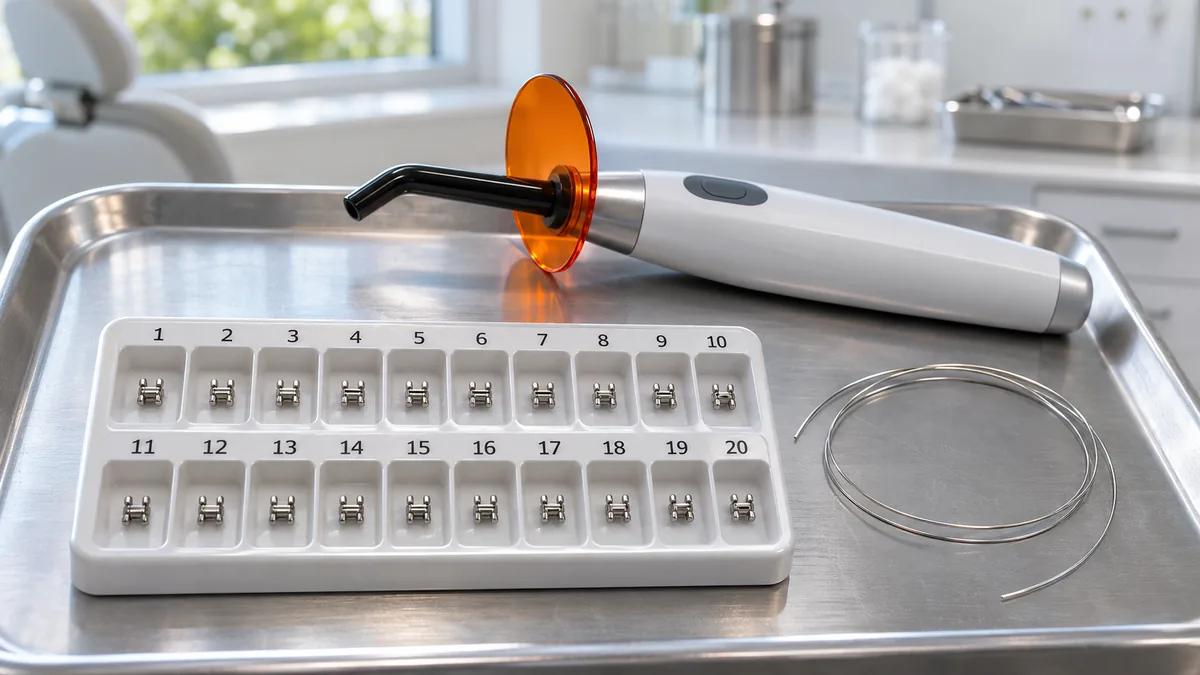
- Minutes 20 to 50: bondingA primer is painted on, a dab of glue goes on each bracket, and each bracket is placed precisely and pressed on. Excess glue is cleaned away and a blue light sets it in seconds per tooth. Some clinics use a tray that places all brackets at once, which is faster.
- Minutes 50 to 60: molar bands, if usedMetal rings cemented around the back molars, where separators were. Some clinics bond molar brackets instead.
- Minutes 60 to 80: the first wireA thin, flexible wire is threaded through the brackets and held in with small elastic ties (this is where colours are chosen) or clips. Wire ends are trimmed behind the last bracket. You will feel a gentle tightness immediately.
- Minutes 80 to 90: instructions and kitBrushing demonstration, food rules, wax, the emergency number, the next appointment. Ask any question now; the sore days are not the time to be searching for answers.
What it feels like
- During: pressure, dryness, a sour taste, an aching jaw from holding it open. No pain.
- Leaving the chair: the lips feel like they cannot close; the teeth feel huge; speech is slightly thick. All of this fades within days.
- That evening: teeth start to ache as the wire begins to work. Soft food, cold drinks, wax on anything that rubs, and a pain reliever if needed. The first 24 hours.
What to do the day before and the morning of
- Eat a proper meal beforehand; you will not want to chew much for the rest of the day.
- Brush and floss thoroughly; clean teeth bond better.
- Bring lip balm; lips dry out under the retractor.
- Bring headphones or a podcast; it is a long, quiet appointment.
- Have soft food and cold drinks at home for the evening. First-week menu.
- Take a before photo.
Aligners: the first-tray visit instead
If the plan is aligners, the equivalent visit is shorter, 30 to 45 minutes. Attachments are bonded using the same conditioning and glue steps, guided by a template tray; any first IPR is done; the first aligners are fitted and checked; and the schedule for changing trays is set. Trays feel tight and speech lisps slightly for a day. Attachments and the Invisalign hub cover what follows.
Why this matters clinically
The conditioning step roughens the enamel surface microscopically so the resin glue can lock into it; this is what lets a bracket carry a wire's force for two years and still come off cleanly at the end. Skipping the drying or contaminating the surface with saliva is the usual reason a bracket comes off early, which is why the retractor and suction are non-negotiable even though they are the unpleasant part.
Questions people ask
Does getting braces on hurt?
No. The appointment is uncomfortable rather than painful. The ache starts hours later and lasts two to four days.
Can I eat after getting braces on?
Yes, soft food straight away. Avoid anything that needs biting or chewing hard for the first few days.
Can I go to school or work afterwards?
Yes. Most people are fine the same day; the soreness is worst on day two or three, which is why a Friday appointment is popular.
References
- Proffit WR, Fields HW, Larson BE, Sarver DM. Contemporary Orthodontics, 6th edition. Elsevier, 2019.
- Monk AB, Harrison JE, Worthington HV, Teague A. Pharmacological interventions for pain relief during orthodontic treatment. Cochrane Database of Systematic Reviews 2017;(11):CD003976. https://doi.org/10.1002/14651858.CD003976.pub2
Where Surrey families get this treatment
Guildford Orthodontic Centre
A specialist orthodontic practice in Guildford where Dr. Aly Kanani and Dr. Aida Mesbahi, both Certified Specialists in Orthodontics, provide braces, Invisalign and growth-appliance treatment for children, teens and adults.
The complimentary first visit includes an examination, photographs and a digital scan, with radiographs when indicated, and ends with a written plan and quote. Braces adjustments, aligner checks, emergency visits and retainer follow-up all happen at the same Guildford office.
- Address
- Suite 200 – 10203 152A Street, Surrey, BC V3R 4H6 (Guildford)
- Hours
- Monday to Saturday, 8 am to 5 pm
- Website
- guildfordorthodontics.com
Disclosure: SurreyBraces.com is a treatment guide published by the myORTHODONTIST network, which operates Guildford Orthodontic Centre. The guidance above applies whoever provides your care. Full disclosure.
About this guide
- Published by
- The myORTHODONTIST network
- Written by
- SurreyBraces.com editorial team
- Clinical reviewer
- Dr. Aida Mesbahi, Certified Specialist in Orthodontics (profile). Review assigned; sign-off date will be shown here once complete.
- First published
- 20 September 2026