Quick answer
Elastics are small rubber bands hooked between upper and lower teeth to pull the jaws into a better relationship. They work only while they are on, so they are worn as prescribed, usually full-time except for eating and brushing, and changed at least once a day because they lose strength. Teeth and jaw muscles ache for the first three to five days. Wearing them half the time does not do half the job; it does close to none of it, because the teeth drift back between wears. Doubling up to catch up is not allowed unless the orthodontist says so.
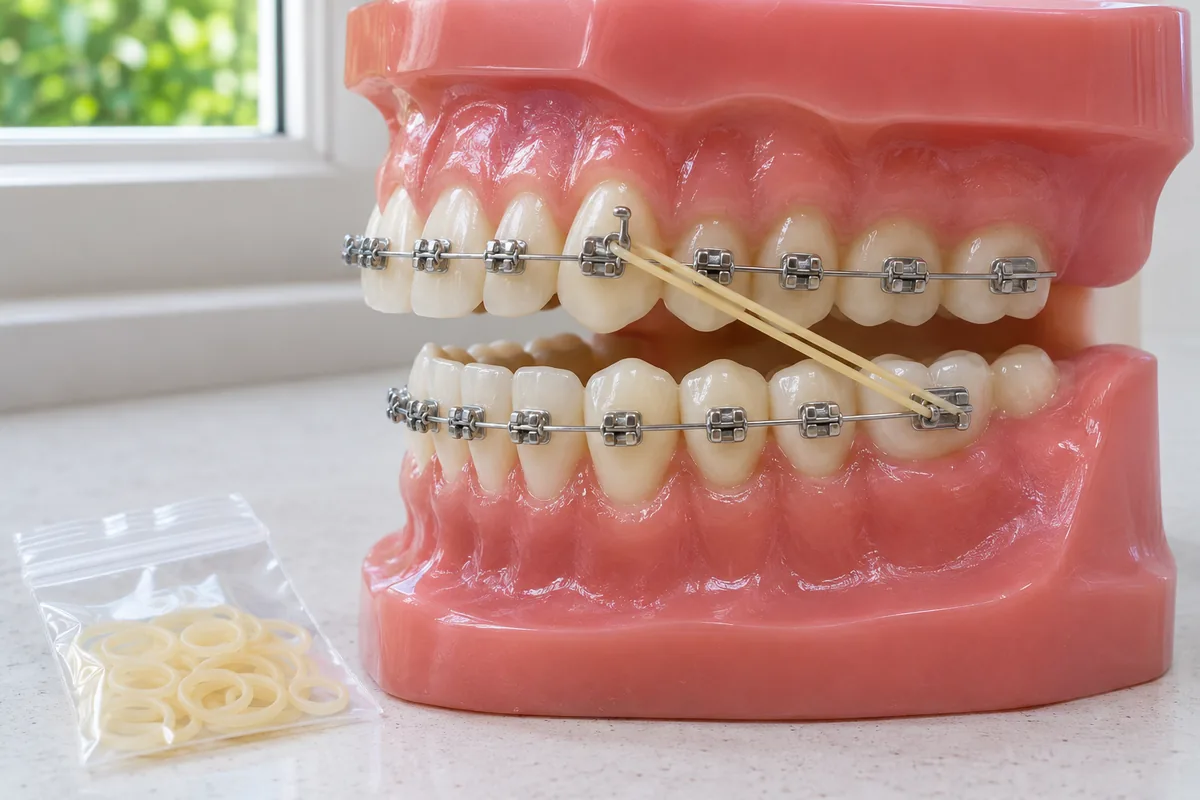
What elastics do
Braces align teeth within each jaw. Elastics move the two arches relative to each other: pulling the upper teeth back and lower teeth forward for a Class II bite (upper teeth ahead), the reverse for a Class III, or across the bite for a crossbite or midline shift, or vertically to close a front open bite. They hook onto small hooks on brackets or bands, or onto buttons bonded for the purpose. The pattern (which hooks, which side) is specific to your plan; the clinic shows you, and a photo of the pattern in your phone is worth taking.
| Pattern | Hooks | Corrects | What it feels like |
|---|---|---|---|
| Class II | Upper canine hook to lower molar hook | Upper teeth ahead of lower | Pulls the lower jaw forward; jaw muscles ache at first |
| Class III | Lower canine hook to upper molar hook | Lower teeth ahead of upper | Pulls the lower jaw back; sore upper molars |
| Cross (crossbite) | Inside of an upper tooth to outside of a lower | A tooth biting on the wrong side | Awkward to place; catches the tongue |
| Triangle or box | Three or four hooks around a group of teeth | Settling the teeth together at the end | Teeth feel pressed together; usually the last months |
| Vertical (anterior) | Upper front to lower front | Open bite | Visible when talking; restricts opening |
How to wear them
- Hours: as prescribed. "Full-time" means all day and all night, out only for eating and brushing. Some plans are nights-only; do not assume.
- Change them at least once a day, and after every meal if they came out. A stretched elastic is a weak elastic.
- Hook from the same side each time so the pattern is right; use the photo on your phone.
- Carry a bag of them everywhere: school bag, sports bag, car, bedside. Running out is the most common reason for a lapse.
- If one breaks, replace it immediately; wearing one side only shifts the midline.
- Do not double up to compensate for missed hours unless told to. Heavy force can damage the ligament and slow movement.
- Bring the elastics to every visit; sizes change as the bite corrects.
The first week on elastics
Teeth ache and jaw muscles feel tired for three to five days, similar to an adjustment. Opening wide is awkward. Speech is unaffected with most patterns; vertical elastics limit opening and are visible. Eating with elastics in is possible with soft food but most people take them out to eat, which is fine as long as fresh ones go straight back in.
What happens when elastics are skipped
| Wear | What happens |
|---|---|
| As prescribed | Bite corrects over months; the plan stays on schedule |
| Most days, with lapses | Correction slows; teeth drift back during lapses; treatment extends by weeks to months |
| Nights only when full-time was prescribed | Little or no correction; the day's drift cancels the night's pull |
| Rarely | The bite does not correct; the orthodontist eventually proposes a fixed alternative (a Class II corrector spring, which is bulkier and less comfortable) or accepts a compromised result |
If elastics are not going well, say so at the next visit rather than nodding. There are fixed alternatives for some corrections, and a short honest conversation beats six extra months.
Why this matters clinically
Bite correction depends on continuous force over months. Elastic force stops the moment the band comes off, and teeth begin returning toward their old positions within hours, so intermittent wear produces a see-saw rather than progress. The orthodontist can see wear compliance at each visit from how the bite has or has not changed, which is why "did you wear them?" is not really a question.
Questions people ask
Do I wear elastics while eating?
You can with soft food. Most people remove them, eat, and put fresh ones in. What matters is that they go straight back.
Do I wear elastics at night?
If prescribed full-time, yes. Night wear is the longest uninterrupted stretch and matters most.
Can I use elastics with Invisalign?
Yes. They hook onto small cut-outs in the trays or onto buttons bonded to the teeth, and are worn with the trays in.
I ran out of elastics. What do I do?
Call or drop in; the clinic will give you more. Do not substitute household elastics.
References
- Proffit WR, Fields HW, Larson BE, Sarver DM. Contemporary Orthodontics, 6th edition. Elsevier, 2019.
- Batista KBSL, Thiruvenkatachari B, Harrison JE, O'Brien KD. Orthodontic treatment for prominent upper front teeth (Class II malocclusion) in children and adolescents. Cochrane Database of Systematic Reviews 2018;(3):CD003452. https://doi.org/10.1002/14651858.CD003452.pub4
Where Surrey families get this treatment
Guildford Orthodontic Centre
A specialist orthodontic practice in Guildford where Dr. Aly Kanani and Dr. Aida Mesbahi, both Certified Specialists in Orthodontics, provide braces, Invisalign and growth-appliance treatment for children, teens and adults.
The complimentary first visit includes an examination, photographs and a digital scan, with radiographs when indicated, and ends with a written plan and quote. Braces adjustments, aligner checks, emergency visits and retainer follow-up all happen at the same Guildford office.
- Address
- Suite 200 – 10203 152A Street, Surrey, BC V3R 4H6 (Guildford)
- Hours
- Monday to Saturday, 8 am to 5 pm
- Website
- guildfordorthodontics.com
Disclosure: SurreyBraces.com is a treatment guide published by the myORTHODONTIST network, which operates Guildford Orthodontic Centre. The guidance above applies whoever provides your care. Full disclosure.
About this guide
- Published by
- The myORTHODONTIST network
- Written by
- SurreyBraces.com editorial team
- Clinical reviewer
- Dr. Aly Kanani, Certified Specialist in Orthodontics (profile). Review assigned; sign-off date will be shown here once complete.
- First published
- 20 September 2026