Quick answer
Aligners correct dental crossbites well: one or two front teeth biting behind the lower teeth, or a back tooth tipped inward. Elastics and bite ramps are often part of the plan. A posterior crossbite caused by a narrow upper jaw is a skeletal problem; in children and young teens it is treated with an expander (Invisalign First can be combined with one), and in adults the options are limited dental tipping with aligners or braces, surgically assisted expansion, or accepting the crossbite if it is not causing harm. A crossbite with a jaw shift on closing is a reason to assess a child early.
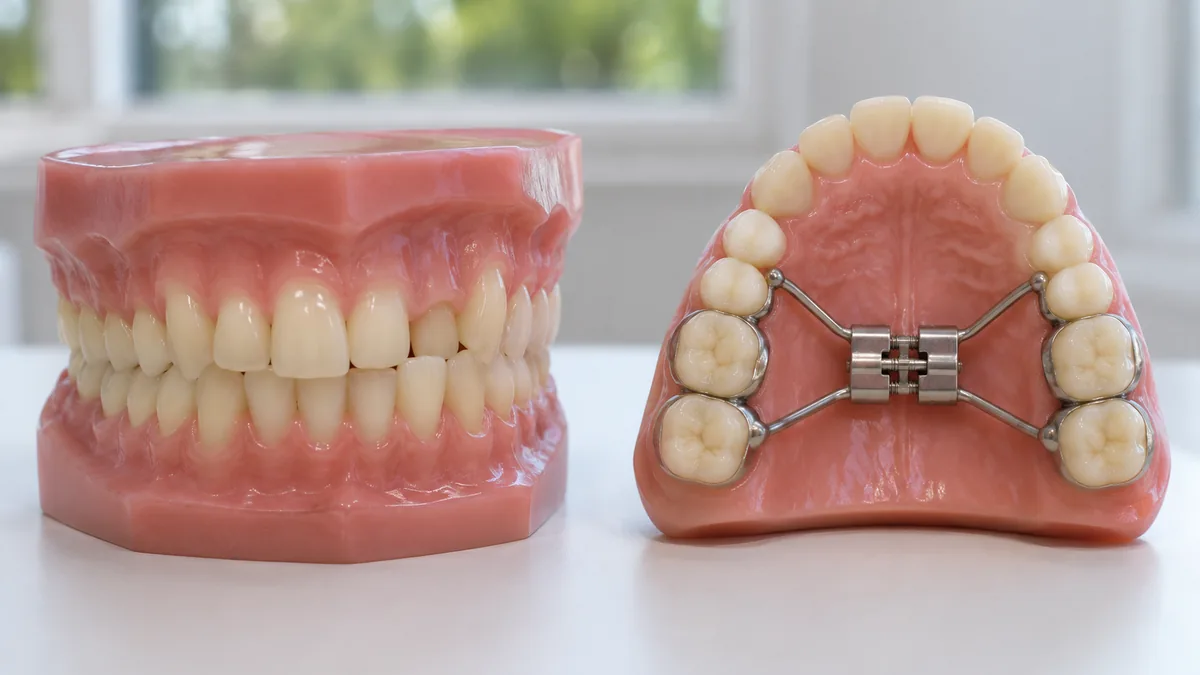
The two kinds, and the two causes
| Feature | Anterior crossbite | Posterior crossbite |
|---|---|---|
| Where | One or more upper front teeth bite behind the lower front teeth | Upper back teeth bite inside the lower back teeth, on one side or both |
| Dental cause | A front tooth erupted behind the arch, often from crowding or a retained baby tooth | A back tooth tipped inward |
| Skeletal cause | The lower jaw is ahead of the upper (an underbite pattern) | The upper jaw is narrow relative to the lower |
| Tell-tale sign | The lower jaw may have to slide forward to get the teeth together | The lower jaw slides to one side on closing; the chin looks off-centre when the teeth are together |
| Why it matters | Wear on the front teeth; gum recession on the lower tooth being hit | Uneven wear; a jaw that grows asymmetrically if the shift persists through childhood |
How aligners correct a dental crossbite
For a front tooth behind the arch, the aligner tips it forward while small bite ramps on the trays keep the back teeth slightly apart so the tooth can jump over the lower teeth. A few weeks of feeling that the bite is "open" at the back is expected and passes once the tooth is over. The same approach is used with braces, where small bite turbos or a bonded ramp do the job the tray ramps do. For a single back tooth tipped inward, the tray tips it out, sometimes with a cross-elastic hooked between an upper and lower button to pull the teeth in opposite directions. These corrections are among the more reliable aligner movements and often take only a few months within a longer plan.
When the problem is the jaw
A narrow upper jaw is not a tooth problem, and tipping teeth outward to disguise it has limits: the roots run into the outer bone and the gum can recede. In a growing child the upper jaw can be widened at its midline suture with an expander. The turning schedule and how long turning continues are set for each patient rather than following a standard recipe, and the appliance is then left in place to hold the new width. This is one of the best-supported reasons for early treatment. Expanders and growth appliances explains what that is like. Invisalign First aligners are sometimes used alongside or after expansion in the mixed dentition.
In adults the suture has usually fused. The options are a modest amount of dental expansion with aligners or braces, mini-screw-assisted expansion, expansion assisted by a minor surgical procedure, or, where the crossbite is not causing wear, recession or jaw symptoms, leaving it alone. An anterior crossbite in an adult with a true underbite is a jaw-relationship question; camouflage or surgery is the decision, and SurreyOrthodontist.com covers how to evaluate that recommendation.
What treatment is like
- Child with an expander: pressure across the nose for a minute after each turn, a gap opening between the front teeth (expected, closes later), speech thick for a few days, extra rinsing to clear food from under the plate.
- Aligners with bite ramps: the back teeth feel apart for a few weeks; chewing is awkward but the tooth is being freed to move.
- Cross-elastics: worn between an upper and lower back tooth; more awkward to place than front elastics; changed daily.
- Duration: a single-tooth dental crossbite, a few months; expansion, a year including holding; full treatment with a crossbite, 12 to 24 months.
- Retention: corrected crossbites hold well once the teeth interlock, but a retainer is still worn; expansion is held for months before anything else moves.
Why this matters clinically
The Cochrane review of posterior crossbite treatment found that expansion appliances in children are effective at correcting the crossbite, and that correcting a crossbite with a functional shift early avoids the jaw growing around the shift. The same review found the evidence for adults much thinner, which is why adult options are presented as trade-offs rather than a single answer.
Questions people ask
Can Invisalign fix a crossbite?
A dental crossbite, usually yes. A skeletal crossbite from a narrow upper jaw needs expansion in a child and is limited or surgical in an adult.
Should a crossbite be treated as soon as possible?
A crossbite with a jaw shift in a child is worth assessing early because the jaw may grow asymmetrically around the shift. A stable single-tooth crossbite can often wait for full treatment. "As soon as possible" is not a rule; assessment is.
Does a crossbite cause headaches or toothache?
Not usually. It can cause uneven wear and gum recession on the tooth being hit. A posterior crossbite with a functional shift is the one pattern that may contribute to jaw discomfort, because the jaw is being loaded asymmetrically every time it closes. Regular toothaches have other causes and need a dentist.
References
- Agostino P, Ugolini A, Signori A, Silvestrini-Biavati A, Harrison JE, Riley P. Orthodontic treatment for posterior crossbites. Cochrane Database of Systematic Reviews 2014;(8):CD000979. https://doi.org/10.1002/14651858.CD000979.pub2
- Papadimitriou A, Mousoulea S, Gkantidis N, Kloukos D. Clinical effectiveness of Invisalign orthodontic treatment: a systematic review. Progress in Orthodontics 2018;19:37. https://doi.org/10.1186/s40510-018-0235-z
- Proffit WR, Fields HW, Larson BE, Sarver DM. Contemporary Orthodontics, 6th edition. Elsevier, 2019.
Where Surrey families get this treatment
Guildford Orthodontic Centre
A specialist orthodontic practice in Guildford where Dr. Aly Kanani and Dr. Aida Mesbahi, both Certified Specialists in Orthodontics, provide braces, Invisalign and growth-appliance treatment for children, teens and adults.
The complimentary first visit includes an examination, photographs and a digital scan, with radiographs when indicated, and ends with a written plan and quote. Braces adjustments, aligner checks, emergency visits and retainer follow-up all happen at the same Guildford office.
- Address
- Suite 200 – 10203 152A Street, Surrey, BC V3R 4H6 (Guildford)
- Hours
- Monday to Saturday, 8 am to 5 pm
- Website
- guildfordorthodontics.com
Disclosure: SurreyBraces.com is a treatment guide published by the myORTHODONTIST network, which operates Guildford Orthodontic Centre. The guidance above applies whoever provides your care. Full disclosure.
About this guide
- Published by
- The myORTHODONTIST network
- Written by
- SurreyBraces.com editorial team
- Clinical reviewer
- Dr. Aida Mesbahi, Certified Specialist in Orthodontics (profile). Clinically reviewed on 21 September 2026.
- Originally published
- 10 May 2021
- Revised
- 20 September 2026. Overstated symptom list and "bad childhood patterns" removed; anterior versus posterior crossbite, dental versus skeletal, expansion in children and the limits of aligners in adults added; the missing treatment section written.