Quick answer
Teeth move after treatment because the bone and gum fibres around them take a year or more to mature, because jaws keep growing subtly into the twenties, because the lips and tongue keep pushing, and because most people see some lower front crowding with age. Retainers counter all of that, which is why a missing or abandoned retainer is behind most relapse. Rotated teeth, closed gaps, open bites and expanded arches relapse most. Slight movement is corrected by wearing a well-fitting retainer full-time; more than that needs a short course of aligners followed by a firmer retention plan, often with a bonded wire.
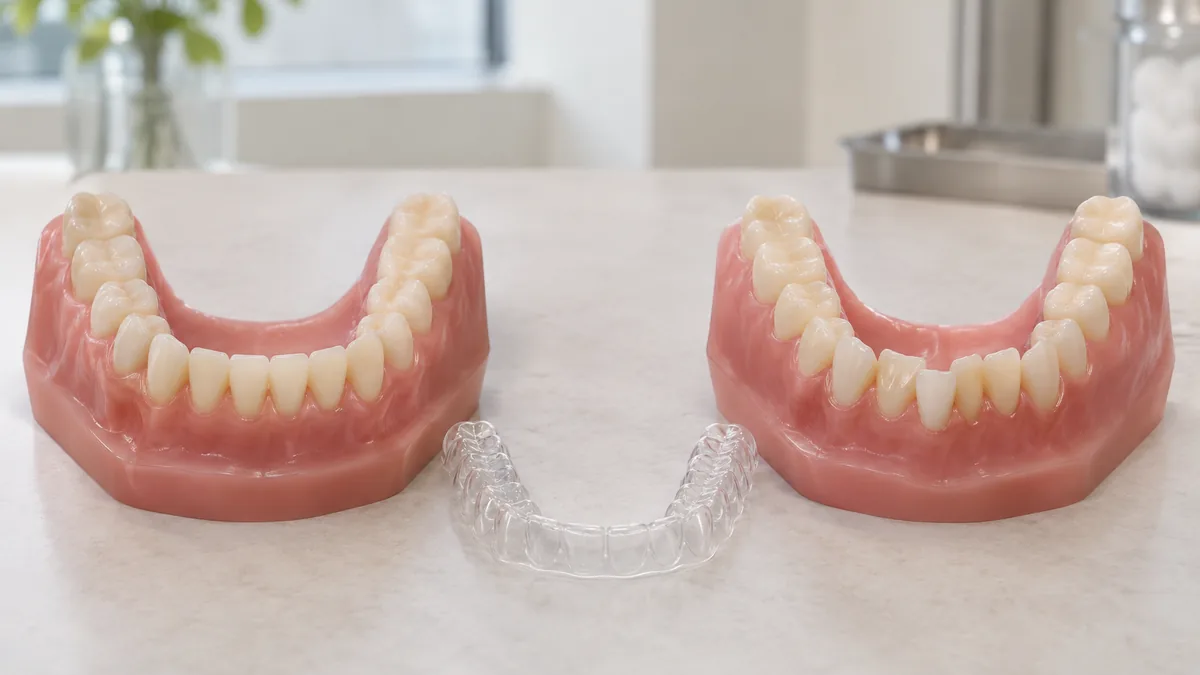
Why teeth move back
| Cause | What counters it |
|---|---|
| Immature bone around moved teeth | Wearing the retainer as prescribed while the bone matures |
| Stretched gum fibres, especially around rotated teeth | Retention; sometimes a minor gum-fibre procedure for severe rotations |
| Continued jaw growth | Night retention through the growing years |
| Lip, cheek and tongue pressure | A stable, well-planned final position; retention |
| Habits (tongue thrust, nail biting) | Habit control; retention |
| Age-related lower incisor crowding | Ongoing night retention; a bonded lower wire |
| Retainer lost, worn out or abandoned | Replacement without delay; a spare set kept at home |
How long each of these acts varies from person to person, which is why retention is planned individually rather than to a fixed schedule. Your orthodontist will set yours.
Which movements relapse most
- Rotations, particularly of round teeth (canines, premolars) and lower incisors. The twisted gum fibres pull back for years.
- Closed spaces, especially a midline gap. Compressed fibres and the frenum push apart. Gaps.
- Anterior open bites, because the tongue posture or growth pattern persists. Open bite.
- Expanded arches, particularly lower arch widening in adults, which the cheeks push back.
- Lower incisor alignment in general, because of age-related crowding.
Corrected crossbites and settled bites, by contrast, tend to hold well once the teeth interlock.
Drift or relapse?
A little crowding of the lower front teeth a decade after treatment is drift; it happens to people who never had braces. Front teeth spacing back out within a year, or a rotation returning, is relapse. The distinction matters less than the response: both are assessed with a scan, and both are treated on a sliding scale.
The options, in order
- A retainer that still seatsWear it full-time for a week or two. Slight movement usually reverses. Then back to your usual schedule, without further gaps. If it is still tight after that, call.
- A retainer that seats with real effort or not at allA new scan and a new retainer made to the current position, accepting the slight change; or a short course of aligners to recover the position, then new retainers.
- Visible relapse of the front teethA short aligner course, often 3 to 9 months, then Vivera retainers plus, usually, a bonded wire. Adult retreatment.
- Relapse of a bite correction or an open biteA fuller assessment. Sometimes aligners with elastics; sometimes braces; occasionally, in adults with a skeletal cause, a surgical conversation.
- Relapse plus new problems (worn teeth, gum recession)Coordinated planning with your dentist before any tooth movement.
Why this matters clinically
Long-term follow-up studies of orthodontic patients, including a well-known series followed for 10 to 20 years after retention ended, found that lower incisor alignment continued to change in most people and that the change was not predictable from the original problem or the treatment. The practical conclusion the profession drew is that retention should be considered long-term, and that relapse is best treated as an expected maintenance issue rather than a failure.
Questions people ask
Is relapse my orthodontist's fault?
Rarely. Some relapse reflects the case (rotations, open bites); most reflects retention that lapsed. A well-planned final position and a clear retention plan reduce it; nothing eliminates the ordinary drift of ageing.
How long does it take to fix relapsed front teeth?
Often 3 to 9 months with aligners, because the bite was corrected once and only the front teeth have moved. Then retainers on the schedule your orthodontist sets, reduced over the years but never stopped, usually with a bonded wire.
Will my teeth keep moving even with a retainer?
Very slightly, over decades. A retainer worn nightly keeps that to a minimum; a bonded wire keeps the lower front teeth where they are.
References
- Little RM, Riedel RA, Artun J. An evaluation of changes in mandibular anterior alignment from 10 to 20 years postretention. American Journal of Orthodontics and Dentofacial Orthopedics 1988;93(5):423-428. https://doi.org/10.1016/0889-5406(88)90102-3
- Littlewood SJ, Millett DT, Doubleday B, Bearn DR, Worthington HV. Retention procedures for stabilising tooth position after treatment with orthodontic braces. Cochrane Database of Systematic Reviews 2016;(1):CD002283. https://doi.org/10.1002/14651858.CD002283.pub4
- Proffit WR, Fields HW, Larson BE, Sarver DM. Contemporary Orthodontics, 6th edition. Elsevier, 2019.
Where Surrey families get this treatment
Guildford Orthodontic Centre
A specialist orthodontic practice in Guildford where Dr. Aly Kanani and Dr. Aida Mesbahi, both Certified Specialists in Orthodontics, provide braces, Invisalign and growth-appliance treatment for children, teens and adults.
The complimentary first visit includes an examination, photographs and a digital scan, with radiographs when indicated, and ends with a written plan and quote. Braces adjustments, aligner checks, emergency visits and retainer follow-up all happen at the same Guildford office.
- Address
- Suite 200 – 10203 152A Street, Surrey, BC V3R 4H6 (Guildford)
- Hours
- Monday to Saturday, 8 am to 5 pm
- Website
- guildfordorthodontics.com
Disclosure: SurreyBraces.com is a treatment guide published by the myORTHODONTIST network, which operates Guildford Orthodontic Centre. The guidance above applies whoever provides your care. Full disclosure.
About this guide
- Published by
- The myORTHODONTIST network
- Written by
- SurreyBraces.com editorial team
- Clinical reviewer
- Dr. Aly Kanani, Certified Specialist in Orthodontics (profile). Review assigned; sign-off date will be shown here once complete.
- First published
- 20 September 2026