Quick answer
A bonded retainer is a thin wire glued behind the lower (sometimes upper) front teeth. It works without any effort, is invisible, and is very good at stopping the lower front teeth crowding and closed gaps reopening; it needs flossing under with a threader and it can debond unnoticed. A removable clear retainer holds every tooth including the back ones, is easy to clean and replace, and only works when worn. At the recommended clinic, Vivera removable retainers are the standard and a bonded lower wire is added case by case. Having both is common and sensible.
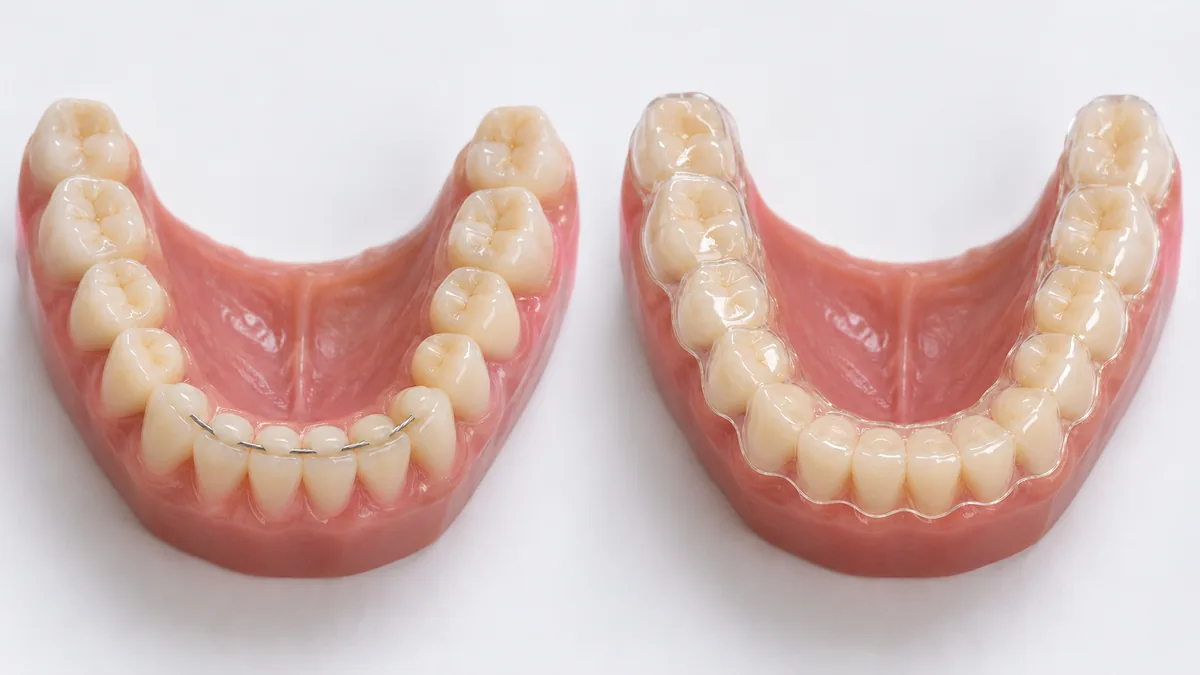
Side by side
| Feature | Bonded (fixed) wire | Removable clear retainer |
|---|---|---|
| What it holds | The teeth it is glued to, usually the lower six front teeth | Every tooth in the arch |
| Effort | None; it is always on | Wear as prescribed, reducing over the years but never stopping |
| Visibility | Invisible | Nearly invisible |
| Cleaning | Floss under it daily with a threader or water flosser; professional cleaning every six months | Brush the tray with cool water; soak weekly; normal flossing of the teeth |
| Failure mode | A section debonds, often unnoticed, and the tooth drifts; the wire can distort if bitten hard | Lost, cracked, warped by heat, chewed by a dog, or simply not worn |
| Repair | Rebond at the clinic; a distorted wire is replaced | Replace from the set (Vivera) or rescan |
| Lifespan | A consumable: replaced when it debonds or distorts; checked at dental visits | A consumable, like eyeglasses: replaced every few years depending on your care and on habits such as grinding and clenching |
| Best at | Lower incisor crowding; closed midline gaps; rotated front teeth | Holding the whole arch, including expansion and bite corrections |
| Not ideal for | People who cannot floss under it; deep bites where the upper teeth hit the wire | People who will not wear it |
What the evidence says
The Cochrane review of retention found no strong evidence that one retainer type or wear schedule is best for everyone, and trials comparing bonded and removable retainers show each holding well when used properly and each failing in its own way. Orthodontists therefore choose by case: a corrected lower crowding or a closed diastema leans toward a bonded wire; an expanded arch or corrected bite needs a removable retainer that holds the back teeth; a patient with poor flossing may do better without a wire. "Both" covers most bases, which is why it is common.
Living with a bonded wire
- Floss under the wire every day: a threader, a floss pick with a stiff end, or a water flosser. Calculus behind the lower front teeth builds fast otherwise.
- Run your tongue along it occasionally; a loose section feels different. Check in a mirror monthly.
- Avoid biting into very hard food with the front teeth; the wire can distort.
- Tell your dentist and hygienist it is there; they clean around it and check it.
- If it debonds on one tooth, call within days and wear your removable retainer full-time meanwhile.
Living with a removable retainer
Covered in full in orthodontic retention and Vivera retainers. The short version: in as prescribed, out only for eating and anything but water, cleaned with cool water and a soft brush, always in its case, and replaced when it wears or goes missing. The failure mode is not wearing it, so the honest question at debond is whether you will; if the answer is doubtful, a bonded wire on top is cheap insurance.
Why this matters clinically
Lower front teeth crowd with age in nearly everyone, treated or not, because the lower arch narrows slightly and the teeth are pushed forward by growth and the lips. A bonded wire resists that specific drift continuously. But it holds only what it touches, so an arch that was widened or a bite that was corrected still needs a removable retainer to hold the back teeth. The two work together rather than competing.
Questions people ask
Do I need both a bonded and a removable retainer?
Many people have both; it depends on what was corrected. The recommended clinic uses Vivera as standard and adds a bonded lower wire case by case.
How long does a bonded retainer last?
A bonded wire is a consumable, like any appliance in the mouth. How long it lasts depends on your bite, on habits such as grinding and clenching, and on not biting hard with the front teeth. Sections can debond and are simply rebonded, so have it checked at your dental visits.
Can I have a bonded retainer removed?
Yes, at any time, but the teeth will begin to drift unless a removable retainer takes over.
References
- Littlewood SJ, Millett DT, Doubleday B, Bearn DR, Worthington HV. Retention procedures for stabilising tooth position after treatment with orthodontic braces. Cochrane Database of Systematic Reviews 2016;(1):CD002283. https://doi.org/10.1002/14651858.CD002283.pub4
- Little RM, Riedel RA, Artun J. An evaluation of changes in mandibular anterior alignment from 10 to 20 years postretention. American Journal of Orthodontics and Dentofacial Orthopedics 1988;93(5):423-428. https://doi.org/10.1016/0889-5406(88)90102-3
- Proffit WR, Fields HW, Larson BE, Sarver DM. Contemporary Orthodontics, 6th edition. Elsevier, 2019.
Where Surrey families get this treatment
Guildford Orthodontic Centre
A specialist orthodontic practice in Guildford where Dr. Aly Kanani and Dr. Aida Mesbahi, both Certified Specialists in Orthodontics, provide braces, Invisalign and growth-appliance treatment for children, teens and adults.
The complimentary first visit includes an examination, photographs and a digital scan, with radiographs when indicated, and ends with a written plan and quote. Braces adjustments, aligner checks, emergency visits and retainer follow-up all happen at the same Guildford office.
- Address
- Suite 200 – 10203 152A Street, Surrey, BC V3R 4H6 (Guildford)
- Hours
- Monday to Saturday, 8 am to 5 pm
- Website
- guildfordorthodontics.com
Disclosure: SurreyBraces.com is a treatment guide published by the myORTHODONTIST network, which operates Guildford Orthodontic Centre. The guidance above applies whoever provides your care. Full disclosure.
About this guide
- Published by
- The myORTHODONTIST network
- Written by
- SurreyBraces.com editorial team
- Clinical reviewer
- Dr. Aida Mesbahi, Certified Specialist in Orthodontics (profile). Review assigned; sign-off date will be shown here once complete.
- First published
- 20 September 2026