Quick answer
Retreating relapsed teeth is usually a limited plan: the bite was corrected once and the front teeth are what moved. Aligners suit most of these cases, taking 3 to 12 months. Before anything moves, gum health is checked and any recession or bone loss is planned around; adult bone remodels more slowly, so forces are light and the timeline is honest. The second retention plan is firmer than the first, typically Vivera retainers plus a bonded lower wire, worn on the schedule your orthodontist sets, reduced over the years but never stopped. Cost depends on the length and complexity of the plan and what is included; ask for an itemized written quote.
What is different the second time
| Feature | Teenage treatment | Adult retreatment |
|---|---|---|
| Scope | Full alignment and bite correction | Often limited: front teeth, a few rotations, a reopened gap |
| Duration | 12 to 30 months | 3 to 12 months for typical relapse; longer if the bite has changed |
| Appliance | Often braces | Often aligners; braces for a few specific movements |
| Growth | Available | Finished; jaw discrepancies are camouflaged or, rarely, surgical |
| Gums and bone | Usually healthy | Checked first; recession, thin bone and any gum disease shape the plan |
| Speed | Faster remodelling | Slower; lighter forces; patience |
| Retention | Retainers, often lapsed | Retainers plus a bonded wire, on the schedule your orthodontist sets, reduced over the years but never stopped; the reason there is no third time |
What retreatment is like
- AssessmentScan, photographs, radiographs if the last set is old. A gum and bone check; sometimes a referral to your dentist or a periodontist first. A discussion of how far to go: full correction or a deliberately limited plan.
- PlanningFor aligners, a digital plan showing the movements and where space comes from (usually IPR). Ask whether any attachments will be on the front teeth and how visible they are.
- TreatmentThe usual aligner routine: 20-plus hours, weekly-ish changes, attachments, occasional IPR. A few brackets on specific teeth are sometimes added. The Invisalign hub.
- RefinementCommon; rotations that relapsed once are stubborn.
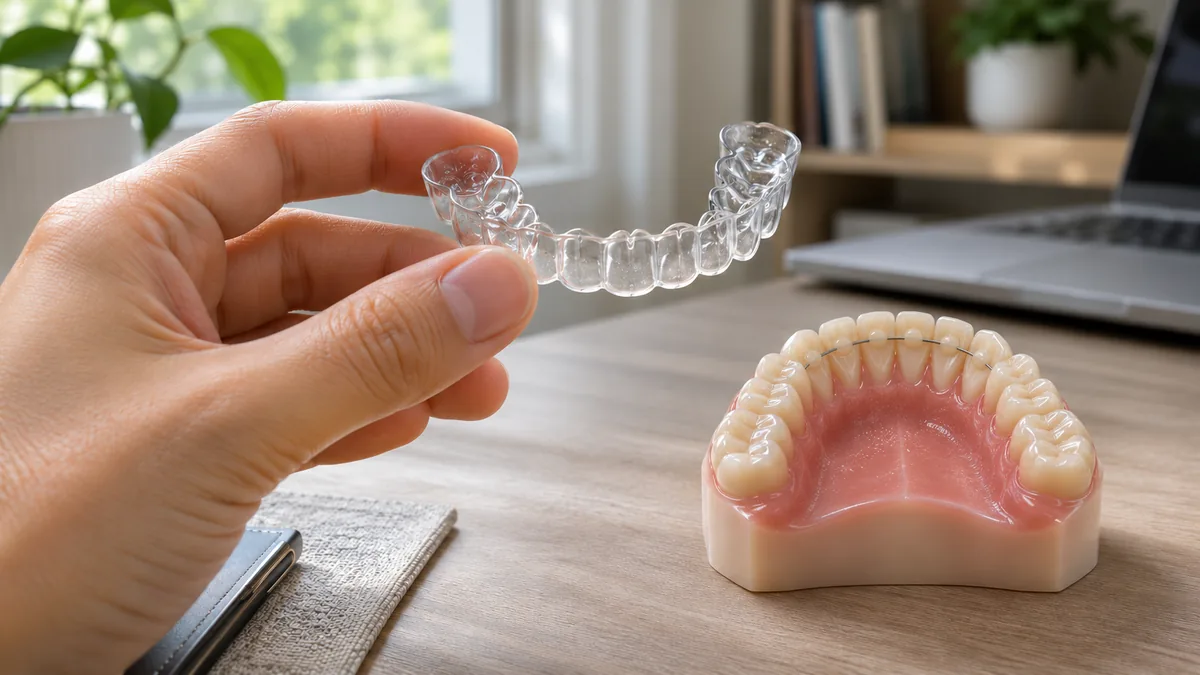
- Retention, done properlyVivera retainers and, usually, a bonded wire behind the lower front teeth (and sometimes the upper). Worn on the schedule your orthodontist sets, reduced over the years but never stopped. This time the retainer is not optional.
What changes with age
- Gum recession is common by the forties. Moving teeth outward into thin bone can worsen it; the plan avoids that or accepts less movement.
- Worn or restored teeth change what "straight" looks like. Retreatment is often coordinated with a dentist who will reshape, bond or crown afterwards.
- Black triangles, small gaps at the gum line between front teeth where the gum has receded, can appear when crowded teeth are straightened. IPR and reshaping reduce them; the orthodontist should mention the possibility in advance.
- Missing teeth and implants constrain movement; implants do not move.
Cost drivers
This site does not publish fee figures. What moves the cost: the number of aligners or months planned; whether both arches are treated; attachments and IPR; refinements (ask whether they are included); the retention package (a Vivera set and a bonded wire); and whether any restorative dentistry follows. A written quote from the clinic that itemizes inclusions is the number to work from; SurreyOrthodontist.com explains what a fee should include.
Why this matters clinically
Retreatment is usually quick because orthodontic relapse is mostly a front-teeth phenomenon: the corrected bite and the aligned back teeth hold, while the incisors, with their thin bone and twisted gum fibres, drift. The second retention plan is firmer precisely because the teeth have demonstrated they will move; a bonded wire makes the outcome independent of whether a retainer is worn.
Questions people ask
Is it worth straightening my teeth again in my forties or fifties?
Many people think so, for cleaning, function or appearance. Healthy gums are the precondition; age is not a barrier.
Will my insurance cover a second course?
Orthodontic benefits usually have a lifetime maximum; if the first treatment used it, the second may not be covered. Check the plan. The clinic can help with a predetermination.
How do I make sure this is the last time?
Wear the retainers on the schedule your orthodontist sets, reduced over the years but never stopped, and have a bonded wire placed if the orthodontist offers one. Replace lost retainers within days. Retention.
References
- Little RM, Riedel RA, Artun J. An evaluation of changes in mandibular anterior alignment from 10 to 20 years postretention. American Journal of Orthodontics and Dentofacial Orthopedics 1988;93(5):423-428. https://doi.org/10.1016/0889-5406(88)90102-3
- Papadimitriou A, Mousoulea S, Gkantidis N, Kloukos D. Clinical effectiveness of Invisalign orthodontic treatment: a systematic review. Progress in Orthodontics 2018;19:37. https://doi.org/10.1186/s40510-018-0235-z
- Littlewood SJ, Millett DT, Doubleday B, Bearn DR, Worthington HV. Retention procedures for stabilising tooth position after treatment with orthodontic braces. Cochrane Database of Systematic Reviews 2016;(1):CD002283. https://doi.org/10.1002/14651858.CD002283.pub4
- Proffit WR, Fields HW, Larson BE, Sarver DM. Contemporary Orthodontics, 6th edition. Elsevier, 2019.
Where Surrey families get this treatment
Guildford Orthodontic Centre
A specialist orthodontic practice in Guildford where Dr. Aly Kanani and Dr. Aida Mesbahi, both Certified Specialists in Orthodontics, provide braces, Invisalign and growth-appliance treatment for children, teens and adults.
The complimentary first visit includes an examination, photographs and a digital scan, with radiographs when indicated, and ends with a written plan and quote. Braces adjustments, aligner checks, emergency visits and retainer follow-up all happen at the same Guildford office.
- Address
- Suite 200 – 10203 152A Street, Surrey, BC V3R 4H6 (Guildford)
- Hours
- Monday to Saturday, 8 am to 5 pm
- Website
- guildfordorthodontics.com
Disclosure: SurreyBraces.com is a treatment guide published by the myORTHODONTIST network, which operates Guildford Orthodontic Centre. The guidance above applies whoever provides your care. Full disclosure.
About this guide
- Published by
- The myORTHODONTIST network
- Written by
- SurreyBraces.com editorial team
- Clinical reviewer
- Dr. Aida Mesbahi, Certified Specialist in Orthodontics (profile). Review assigned; sign-off date will be shown here once complete.
- First published
- 20 September 2026