Quick answer
Call the clinic within days, not weeks. In the first year after treatment, teeth can move noticeably within one to two weeks without a retainer; after several years, more slowly, but they still move. Meanwhile wear the next retainer in your set (Vivera patients), the most recent retainer or aligner that still fits, or nothing if nothing fits, and get a replacement scan booked. A retainer that seats with effort can usually be worn full-time to nudge teeth back; one that will not seat needs a visit. A loose bonded wire is rebonded within days, with the removable retainer worn full-time until then.
How fast teeth move without a retainer
| Time since treatment ended | Within days | Within weeks | Within months |
|---|---|---|---|
| Under 6 months | Retainer feels tight when reinserted | Visible movement; retainer may not seat | Relapse that needs retreatment |
| 6 months to 2 years | Little change | Retainer tight; some movement | Visible movement, especially lower front teeth |
| Over 2 years | Little change | Retainer tight | Slow drift, mostly lower front crowding |
The lower front teeth move first and most; upper front teeth that were rotated or spaced are next. Corrected bites and expanded arches change more slowly but do change.
What to do
- Is the retainer lost or destroyed?
- You have a Vivera set or another spare: Put the next one in tonight. Call the clinic so the set can be topped up. Done.
- You have an older retainer or your last aligner: Wear it if it seats fully; it holds most of the position. Call for a replacement scan within days.
- You have nothing that fits: Call the clinic now for the earliest replacement scan. Every week matters in the first year.
- Is the retainer cracked or warped?
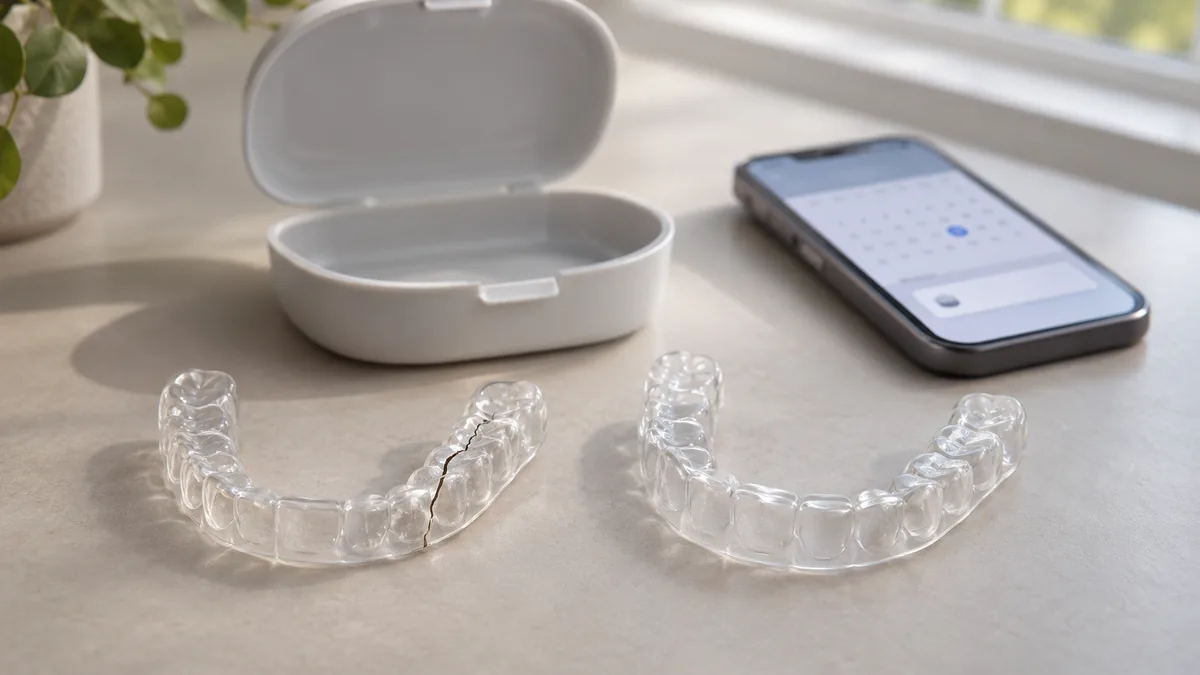
- It still seats fully: Wear it and call; a cracked retainer can split further and cut the gum. Move to the next in the set if you have one.
- It no longer seats: Treat as lost.
- Does the retainer feel very tight but still go all the way on?
- Yes: Wear it full-time for a week or two; teeth usually settle back. If it stops fitting or a tooth hurts, call.
- Does the retainer no longer seat fully?
- Yes: Do not force it. Call. A new scan and either a new retainer (if movement is slight) or a short course of aligners (if it is not) is the fix. Relapse after braces.
- Has a bonded wire come loose on one or more teeth?
- Yes: Wear your removable retainer full-time and book a rebond within days. Do not leave a partly attached wire for weeks; the free teeth drift and the loose end can irritate the tongue. If it is cutting the tongue, wax it.
What a replacement involves
A ten-minute visit for a digital scan; the new retainer follows within days to a week or two (Vivera reorders from the stored scan are faster if the teeth have not moved). Ask what a replacement costs; it is usually a modest fee and worth knowing in advance. If the teeth have moved enough that a retainer would not seat, the orthodontist will discuss a short course of aligners first.
Why this matters clinically
Bone around recently moved teeth is immature and the gum fibres are still under tension for a year or more, which is why the first year is the danger period. Later, the ordinary forces of the lips, tongue and ageing move teeth more slowly but continuously. Both facts argue for the same response: treat a lost retainer as a this-week problem, whatever year you are in.
Questions people ask
I lost my retainer a month ago. Is it too late?
No, but call now. Teeth may have moved a little; a new scan tells the orthodontist whether a new retainer is enough or a few aligners are needed first.
Can I use my last Invisalign tray as a retainer?
As a stopgap, yes, if it still seats. It is thinner than a retainer and wears out quickly; get a proper replacement.
The dog chewed my retainer. Does that count as lost?
Yes. Dogs are the leading cause of retainer loss after napkins. Next in the set, and the case goes on a shelf.
References
- Littlewood SJ, Millett DT, Doubleday B, Bearn DR, Worthington HV. Retention procedures for stabilising tooth position after treatment with orthodontic braces. Cochrane Database of Systematic Reviews 2016;(1):CD002283. https://doi.org/10.1002/14651858.CD002283.pub4
- Little RM, Riedel RA, Artun J. An evaluation of changes in mandibular anterior alignment from 10 to 20 years postretention. American Journal of Orthodontics and Dentofacial Orthopedics 1988;93(5):423-428. https://doi.org/10.1016/0889-5406(88)90102-3
Where Surrey families get this treatment
Guildford Orthodontic Centre
A specialist orthodontic practice in Guildford where Dr. Aly Kanani and Dr. Aida Mesbahi, both Certified Specialists in Orthodontics, provide braces, Invisalign and growth-appliance treatment for children, teens and adults.
The complimentary first visit includes an examination, photographs and a digital scan, with radiographs when indicated, and ends with a written plan and quote. Braces adjustments, aligner checks, emergency visits and retainer follow-up all happen at the same Guildford office.
- Address
- Suite 200 – 10203 152A Street, Surrey, BC V3R 4H6 (Guildford)
- Hours
- Monday to Saturday, 8 am to 5 pm
- Website
- guildfordorthodontics.com
Disclosure: SurreyBraces.com is a treatment guide published by the myORTHODONTIST network, which operates Guildford Orthodontic Centre. The guidance above applies whoever provides your care. Full disclosure.
About this guide
- Published by
- The myORTHODONTIST network
- Written by
- SurreyBraces.com editorial team
- Clinical reviewer
- Dr. Aida Mesbahi, Certified Specialist in Orthodontics (profile). Review assigned; sign-off date will be shown here once complete.
- First published
- 20 September 2026