Quick answer
Brass players (trumpet, French horn especially) have the biggest adjustment: the mouthpiece presses the lip against the brackets, which hurts at first and changes the feel of the embouchure. Wax or a silicone lip protector over the front brackets, shorter practice sessions and patience get most players back to normal in two to four weeks. Reed players adjust faster; flute players fastest. Singers are barely affected. Aligner wearers usually play with trays in and notice little. Book bond day at least three, and ideally four, weeks before an audition, exam or concert.
By instrument
| Instrument | Adjustment | What helps |
|---|---|---|
| Trumpet, cornet, French horn | Largest; high mouthpiece pressure on the upper lip against brackets; range and endurance drop for a few weeks | Wax or a lip protector; short frequent sessions; softer dynamics; expect the high register to return last |
| Trombone, euphonium, tuba | Moderate; larger mouthpiece spreads pressure | Lip protector at first; usually settles within two weeks |
| Clarinet, saxophone | Moderate; lower lip rolls over lower teeth, so lower braces matter more than upper | Wax on the lower brackets; a slightly softer reed for a week or two |
| Oboe, bassoon | Moderate; double reed sits between the lips | Wax; short sessions |
| Flute, piccolo | Small; lip plate rests below the lip | Little needed; airstream angle may shift slightly |
| Recorder, harmonica | Small | Wax if the lip rubs |
| Voice | Minimal; slight change in resonance and some sibilants for a few days | Practise vowels; nothing else needed |
Protecting the lips
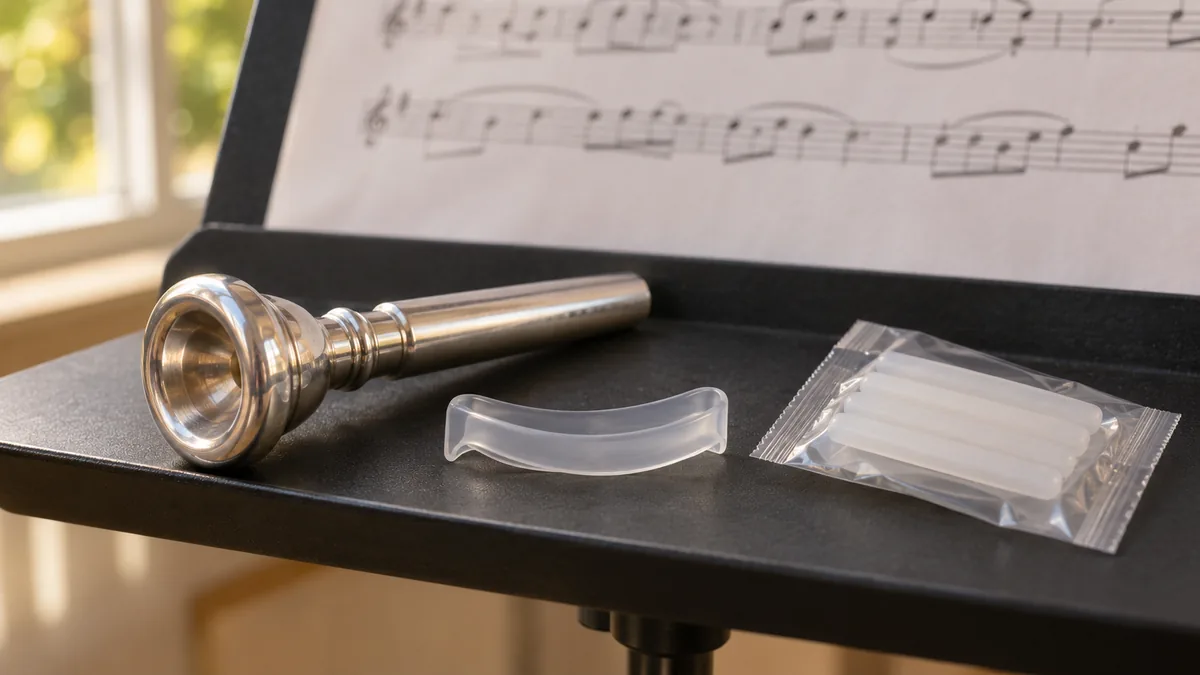
- Orthodontic wax pressed over the front four to six brackets before playing. Replace after each session. Cheap and effective.
- Silicone lip protectors (a soft strip that clips over the brackets) are sold for musicians and last longer than wax. Ask the clinic or a music store.
- Ceramic brackets are slightly larger and smoother-edged than metal; some brass players choose them for that reason. Metal versus ceramic.
- Aligners are the gentlest option for a serious wind player: thin, smooth, and worn while playing. Some players remove them for performance and count the hours.
Timing and practice
- Book bond day at least three, ideally four, weeks before any audition, exam or concert.
- Tell the teacher; a good teacher will adjust repertoire for a few weeks rather than push the high register.
- Practise in three short sessions rather than one long one during the first two weeks.
- Play through the sore days after each adjustment gently; skipping a week sets the embouchure back.
- Expect a second, smaller adjustment at debond, when the brackets come off and the lip suddenly has room again.
Why this matters clinically
The embouchure is a learned muscular pattern that depends on the exact contact between lip, teeth and mouthpiece. Brackets change that contact and the lip tissue needs to toughen where the mouthpiece presses, which is the same keratinization that happens for everyone in the first weeks. The nervous system relearns the pattern within weeks; the range and endurance return once the lip stops hurting.
Questions people ask
Should I wait until after braces to start trumpet?
No. Children learn instruments with braces all the time. Start when you like; adjust expectations for the first month of braces and the first weeks after debond.
Can I get braces on my lower teeth only to protect my upper lip?
Treatment is planned around the bite, not the instrument. If the upper lip is the concern, ask about ceramic brackets, a lip protector or aligners; do not compromise the plan.
Do aligners affect singing?
Slightly for a day or two with each new tray (a mild lisp on s sounds). Singers usually adapt immediately.
References
- Proffit WR, Fields HW, Larson BE, Sarver DM. Contemporary Orthodontics, 6th edition. Elsevier, 2019.
Where Surrey families get this treatment
Guildford Orthodontic Centre
A specialist orthodontic practice in Guildford where Dr. Aly Kanani and Dr. Aida Mesbahi, both Certified Specialists in Orthodontics, provide braces, Invisalign and growth-appliance treatment for children, teens and adults.
The complimentary first visit includes an examination, photographs and a digital scan, with radiographs when indicated, and ends with a written plan and quote. Braces adjustments, aligner checks, emergency visits and retainer follow-up all happen at the same Guildford office.
- Address
- Suite 200 – 10203 152A Street, Surrey, BC V3R 4H6 (Guildford)
- Hours
- Monday to Saturday, 8 am to 5 pm
- Website
- guildfordorthodontics.com
Disclosure: SurreyBraces.com is a treatment guide published by the myORTHODONTIST network, which operates Guildford Orthodontic Centre. The guidance above applies whoever provides your care. Full disclosure.
About this guide
- Published by
- The myORTHODONTIST network
- Written by
- SurreyBraces.com editorial team
- Clinical reviewer
- Dr. Aly Kanani, Certified Specialist in Orthodontics (profile). Review assigned; sign-off date will be shown here once complete.
- First published
- 20 September 2026