Quick answer
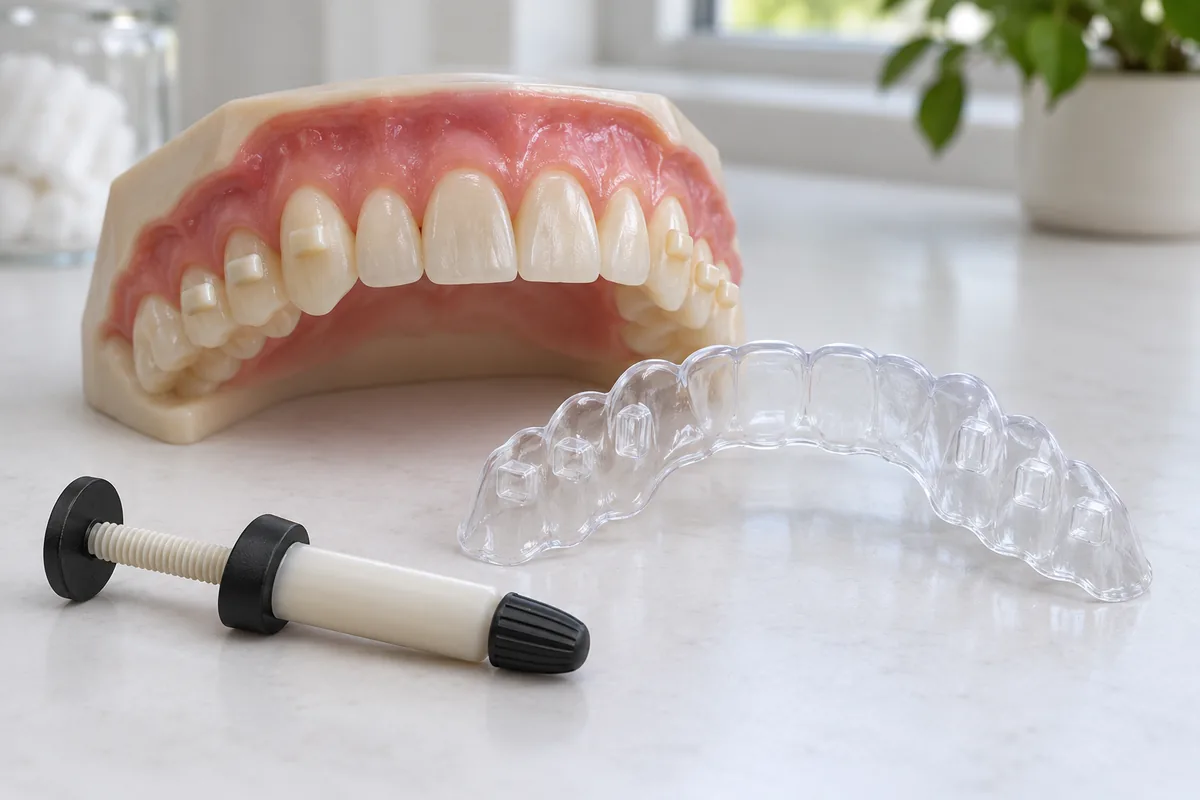
Attachments are small shapes of tooth-coloured filling material bonded to selected teeth so that an aligner can grip and push them in directions a smooth tray cannot: rotations, root movements, extrusions. They are placed in 10 to 20 minutes, usually without discomfort, at the first visit using a template tray, feel rough to the tongue and lip for a week, are slightly visible up close (more on the front teeth), do not stain themselves though the edges can, and are polished off at the end of treatment leaving the enamel intact. A lost attachment is not urgent but should be replaced within a couple of weeks.
Why aligners need them
A smooth plastic tray on a smooth tooth can tip the crown but has nothing to push against for rotating a round tooth, moving a root, or pulling a tooth down. An attachment is a handle: a tiny ramp or ridge on the tooth surface that the aligner fits over precisely. The plan software decides where they go and what shape; the orthodontist reviews and adjusts. The number varies from none (rare, simple cases) to a dozen or more.
| Shape | Typical use | Where |
|---|---|---|
| Rectangular or ellipsoid | Rotations and general grip | Canines, premolars |
| Bevelled (ramp) | Extrusion (pulling a tooth down) or intrusion | Front teeth, premolars |
| Power ridge (a raised bar) | Root torque on front teeth | Upper front teeth |
| Precision cuts and buttons | Elastic hooks, not attachments strictly | Canines and molars |
Placement and removal
- Placement (10 to 20 minutes)Teeth are cleaned, conditioned with a mild gel and dried. A template tray with attachment-shaped wells is filled with composite, seated on the teeth, and set with a blue light. The template is removed and excess is polished. No drilling; usually no discomfort.
- The first weekRough to the tongue and inside of the lip; a slight lisp; trays feel very tight because they now grip. It settles within days. Wax on any edge that rubs.
- During treatmentAttachments are checked at each visit. They can be added, removed or reshaped for refinements.
- Removal (10 minutes)At the end, each attachment is polished off with a fine bur and the enamel is smoothed. The enamel underneath is unharmed. The teeth feel oddly smooth afterwards.
Visibility and staining
Attachments are matched to tooth colour and are nearly invisible with the tray in; with the tray out, they are visible up close as small bumps, more so on the front teeth. They do not stain, but the margin where composite meets enamel can pick up colour from coffee, tea, red wine and smoking, and plaque collects around them. Brushing around each attachment as you would around a bracket keeps the edges clean.
A lost attachment
- It is not urgent. Keep wearing the current tray; it will feel slightly loose on that tooth.
- Call the clinic; they will replace it, usually within a couple of weeks, using the template.
- Do not skip ahead to catch up. A tooth without its attachment may stop tracking, and the next trays may fit worse.
- Repeated losses on the same tooth may mean a bonding problem or a bite that hits the attachment; the clinic can reshape or relocate it.
Why this matters clinically
Studies of aligner accuracy show that rotations, extrusions and root movements are achieved far less fully without attachments, which is why plans without them are limited to simple tipping. Attachments turn an aligner from a tray that tips crowns into an appliance that can control roots, and they are the main reason modern aligner treatment can take on cases that were once braces-only.
Questions people ask
Do attachments hurt?
Rarely. Placement is usually not uncomfortable. They feel rough for about a week and trays are tighter because they grip better.
Can I ask for no attachments?
You can ask; the answer depends on the movements needed. Fewer attachments usually means less predictable movement and more refinements.
Do attachments damage enamel?
No. They bond to conditioned enamel and are polished off at the end, leaving the surface intact.
References
- Papadimitriou A, Mousoulea S, Gkantidis N, Kloukos D. Clinical effectiveness of Invisalign orthodontic treatment: a systematic review. Progress in Orthodontics 2018;19:37. https://doi.org/10.1186/s40510-018-0235-z
- Kravitz ND, Kusnoto B, BeGole E, Obrez A, Agran B. How well does Invisalign work? A prospective clinical study evaluating the efficacy of tooth movement with Invisalign. American Journal of Orthodontics and Dentofacial Orthopedics 2009;135(1):27-35. https://doi.org/10.1016/j.ajodo.2007.05.018
Where Surrey families get this treatment
Guildford Orthodontic Centre
A specialist orthodontic practice in Guildford where Dr. Aly Kanani and Dr. Aida Mesbahi, both Certified Specialists in Orthodontics, provide braces, Invisalign and growth-appliance treatment for children, teens and adults.
The complimentary first visit includes an examination, photographs and a digital scan, with radiographs when indicated, and ends with a written plan and quote. Braces adjustments, aligner checks, emergency visits and retainer follow-up all happen at the same Guildford office.
- Address
- Suite 200 – 10203 152A Street, Surrey, BC V3R 4H6 (Guildford)
- Hours
- Monday to Saturday, 8 am to 5 pm
- Website
- guildfordorthodontics.com
Disclosure: SurreyBraces.com is a treatment guide published by the myORTHODONTIST network, which operates Guildford Orthodontic Centre. The guidance above applies whoever provides your care. Full disclosure.
About this guide
- Published by
- The myORTHODONTIST network
- Written by
- SurreyBraces.com editorial team
- Clinical reviewer
- Dr. Aly Kanani, Certified Specialist in Orthodontics (profile). Review assigned; sign-off date will be shown here once complete.
- First published
- 20 September 2026