Quick answer
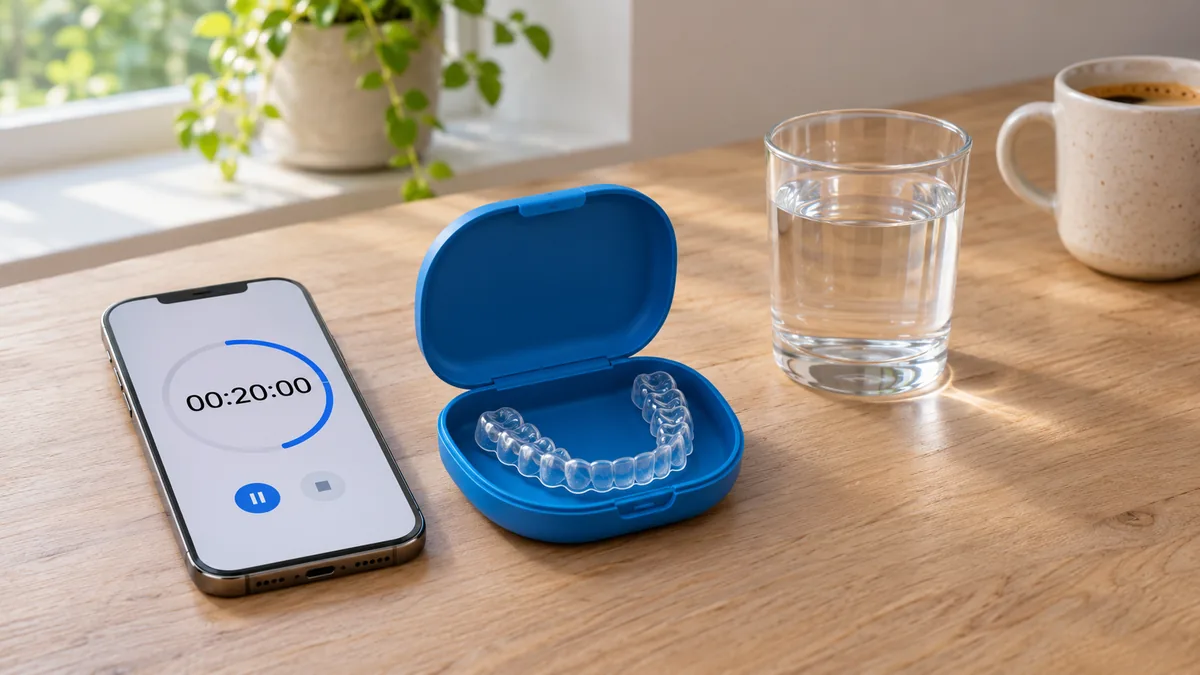
Aligners must be in for 20 or more hours out of every 24; the recommended clinic treats 20 as the minimum. Meals and brushing have to fit into what is left. Below that, teeth stop tracking the trays and each new one fits worse. Change trays on the schedule your orthodontist sets, counting days from the last change. If a tray is lost, put in the previous one immediately (or the next, if the clinic agrees) and call the same day. If a tray no longer seats fully, go back to the last one that does and call; forcing it does not work.
Why 20 hours
An aligner only moves teeth while it is on them. Bone remodelling needs sustained pressure; when the tray is out for long stretches, the ligament and bone start to stabilize the tooth where it is, and the next tray, which assumes the previous movement happened, no longer fits. A slightly higher figure was traditionally quoted; 20 is the standard used at the recommended clinic and the practical floor. More is better, and an extra hour or two a day adds up over a year.
Counting honestly
Most people overestimate their wear time, and it is rarely meals that cost them it. Trays come out for every drink that is not water, and a coffee here and a soft drink there add up faster than the three meals do. Grazing through the day is the other common drain: each small snack means the trays come out, teeth are cleaned and the trays go back in.
The habit that fixes it is simply getting the trays back in as soon as you have finished and cleaned your teeth, rather than leaving them out until the next time you think of them. A timer app, or noting the time the trays come out, keeps the count honest. Trays out at a long dinner with friends is fine once; every night, it is not. If you are unsure whether your wear time is where it needs to be, your orthodontist can tell from how the trays are tracking.
Changing trays
- Change on the schedule set by the orthodontist, in days counted from the last change. Weekly is common; some movements are prescribed longer. The old two-week rule is not universal.
- Change at night, so the tightest hours are spent asleep.
- Use chewies for five minutes after inserting a new tray to seat it fully.
- If the current tray still feels tight on change day after a poor-wear week, wear it two or three more days before moving on. Do not skip trays to catch up.
- Keep the previous tray until the next one has been worn a few days. Then keep the most recent one as the standing backup.
Tracking problems
"Tracking" means the teeth are following the plan. A tray that seats fully with no gap between its edge and the gum line is tracking. A visible gap at the biting edge of a tooth, especially a canine or a lateral incisor, means that tooth is lagging. Chewies and more hours often fix it within a week. If not, tell the clinic; a refinement scan or an attachment tweak may be needed. Ignoring a lagging tooth for several trays makes the problem bigger.
Lost, cracked or ill-fitting
- The current tray is lost
- The previous tray is available: Put it in now. Call the clinic the same day. Depending on where you are in the tray's schedule, they may advise moving to the next tray early or ordering a replacement.
- The previous tray is gone too: Put in the next tray if you have it and it seats reasonably; call the same day. If nothing fits, call; teeth can drift within days.
- The current tray is cracked
- It still seats fully: Keep wearing it, or move to the next tray if the crack is spreading and the clinic agrees. Call.
- It no longer seats: Treat as lost.
- A tray no longer seats fully after a lapse in wear
- Any: Do not force it. Go back to the last tray that seats fully and wear it full-time. Call; a new scan may be needed. A few days of lapse is usually recoverable; a few weeks usually means a refinement.
- A tray has a sharp edge
- Yes: Smooth it with a clean emery board or a nail file, or put wax on it. Not urgent.
Why this matters clinically
The predictability of aligner treatment depends on each tray finding the teeth where the previous tray left them. Wear below the threshold breaks that chain, and the errors compound tray by tray, which is why refinements (a new scan and a fresh series) exist. Most refinements in practice trace back to wear time or a lost tray rather than to the plan itself.
Questions people ask
What if I only wear my aligners at night?
Treatment stops. Eight or nine hours is less than half the required wear; the teeth drift back during the day. Night-only wear is for retainers, not aligners.
Can I skip to the next tray if I lose one?
Only if the clinic agrees; it depends on how many days the lost tray had been worn. Otherwise go back to the previous one and call.
Is there a charge for replacement aligners?
Policies vary. Invisalign Teen includes some replacements. Ask the recommended clinic what the fee agreement says.
References
- Papadimitriou A, Mousoulea S, Gkantidis N, Kloukos D. Clinical effectiveness of Invisalign orthodontic treatment: a systematic review. Progress in Orthodontics 2018;19:37. https://doi.org/10.1186/s40510-018-0235-z
- Kravitz ND, Kusnoto B, BeGole E, Obrez A, Agran B. How well does Invisalign work? A prospective clinical study evaluating the efficacy of tooth movement with Invisalign. American Journal of Orthodontics and Dentofacial Orthopedics 2009;135(1):27-35. https://doi.org/10.1016/j.ajodo.2007.05.018
Where Surrey families get this treatment
Guildford Orthodontic Centre
A specialist orthodontic practice in Guildford where Dr. Aly Kanani and Dr. Aida Mesbahi, both Certified Specialists in Orthodontics, provide braces, Invisalign and growth-appliance treatment for children, teens and adults.
The complimentary first visit includes an examination, photographs and a digital scan, with radiographs when indicated, and ends with a written plan and quote. Braces adjustments, aligner checks, emergency visits and retainer follow-up all happen at the same Guildford office.
- Address
- Suite 200 – 10203 152A Street, Surrey, BC V3R 4H6 (Guildford)
- Hours
- Monday to Saturday, 8 am to 5 pm
- Website
- guildfordorthodontics.com
Disclosure: SurreyBraces.com is a treatment guide published by the myORTHODONTIST network, which operates Guildford Orthodontic Centre. The guidance above applies whoever provides your care. Full disclosure.
About this guide
- Published by
- The myORTHODONTIST network
- Written by
- SurreyBraces.com editorial team
- Clinical reviewer
- Dr. Aida Mesbahi, Certified Specialist in Orthodontics (profile). Review assigned; sign-off date will be shown here once complete.
- First published
- 20 September 2026