Quick answer
After you agree to a plan, the clinic finalizes records (a scan, photographs and any radiographs not already taken), designs the appliance or aligner sequence, and books the fitting. In that gap you may need a dental check-up and cleaning, any fillings completed, extractions done if the plan includes them, and separators placed a week before molar bands. It is also the time to file an insurance predetermination and to choose a start date that avoids exams, trips and performances.
The sequence
- Consent and planYou sign the treatment consent and fee agreement. Read the inclusions: adjustments, emergency visits, retainers, refinements, replacement retainers. Ask what happens to the fee if treatment runs long.
- Records completedAnything not taken at the assessment: the cephalometric radiograph, a CBCT scan for impacted teeth, an updated scan. For aligners, the digital plan is built from the scan and reviewed by the orthodontist; you may be shown a simulation.
- Dental preparationA cleaning and check-up with your general dentist, and any fillings, before the appliance goes on. Decay under a bracket is a problem; decay under an aligner is a bigger one.
- Extractions, if plannedDone by your dentist or an oral surgeon, usually one to two weeks before bond day so the sockets settle. Questions to ask when extractions are discussed (SurreyOrthodontist.com).
- Separators (braces with molar bands)Small elastic rings placed between the back teeth a week before bonding, so bands can slide on. They ache like a piece of food stuck between the teeth for a few days. No sticky food; do not floss them out.
- Bond day or first-aligner visitThe appliance goes on. Bond day.
Insurance and the predetermination
Many extended health plans in BC include orthodontic coverage with a lifetime maximum and a percentage of the fee. The clinic sends a predetermination to the insurer with the plan and fee; the insurer confirms what it will pay and how (often in instalments over treatment). File it before bond day so the first payment is not a surprise. A second family member's plan can sometimes coordinate benefits. This site does not publish fee figures; the written quote from the clinic is the number to work from, and SurreyOrthodontist.com explains what a quote should include.
Choosing the start date
- Exams and major assignments in the week after (the soreness lasts three or four days and is worst on day two or three).
- A school trip, camp, tournament or performance within two weeks; the first week is the adjustment period for eating and speech.
- Travel abroad within the first month; the first poking wire tends to happen early.
- A wedding or photographs within a week (ceramic and aligners aside, the first days look and feel awkward).
Things worth doing in the gap
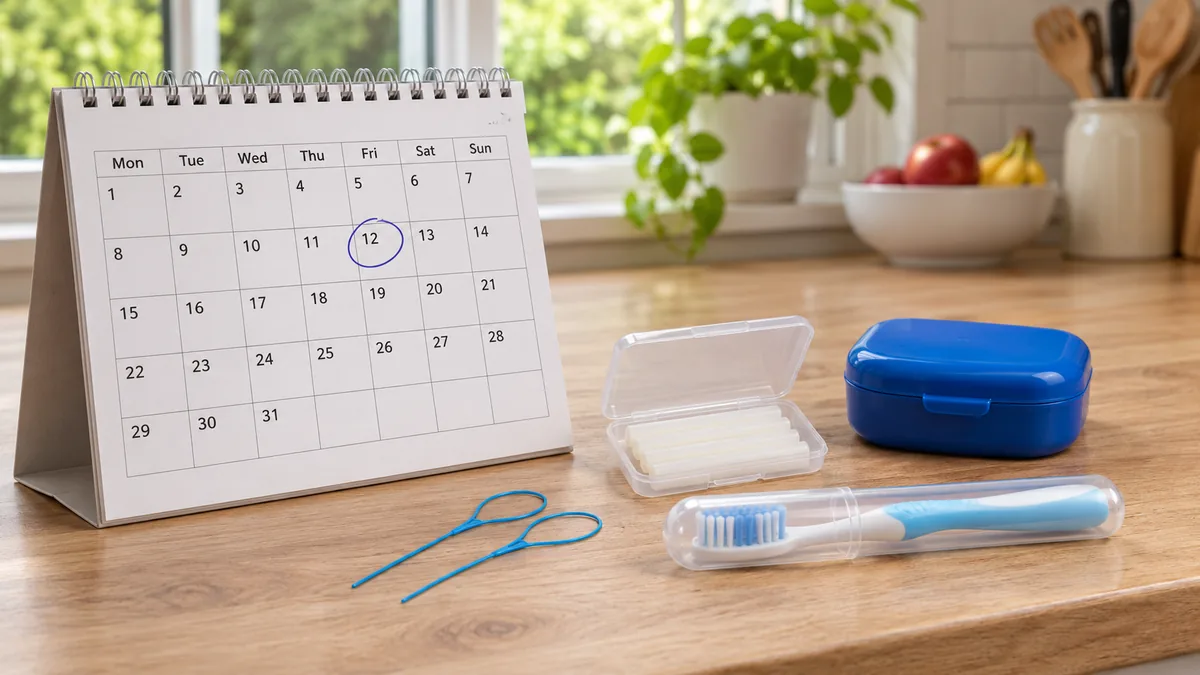
- Assemble the starter kit: wax, a travel brush, floss threaders or a water flosser, a small mirror, soft food for the first days.
- Read eating with braces and stock the kitchen accordingly, or, for aligners, decide where the case will live.
- Tell the school: a short note to the teacher about a few days of soft food and a rinse after lunch. Braces at school.
- Buy an orthodontic mouthguard if the person plays any contact or ball sport. Sports and mouthguards.
- Take a "before" photo at home. The change is gradual enough that most people forget where they started.
Why this matters clinically
Bonding onto teeth with untreated decay or inflamed gums invites problems that are hard to fix once the appliance is on, and a plaque-heavy mouth is at risk of permanent white marks from the first week. The dental preparation step is the single most protective thing in this whole stage, which is why the recommended clinic asks for a recent check-up before starting.
Questions people ask
How long between the consultation and getting braces on?
Typically one to four weeks, longer if extractions or dental work are needed or if the orthodontist is waiting for growth or eruption.
Do separators hurt?
They ache for two to four days, like something wedged between the teeth. Soft food and a pain reliever if needed. Do not floss them out; if one falls out, call.
Can I see the aligner plan before I commit?
Usually yes. Ask to be shown the digital simulation and where the space comes from (IPR, expansion, tipping). The simulation is a plan, not a guarantee; refinements are normal.
References
- Proffit WR, Fields HW, Larson BE, Sarver DM. Contemporary Orthodontics, 6th edition. Elsevier, 2019.
- Benson PE, Parkin N, Dyer F, Millett DT, Germain P. Fluorides for preventing early tooth decay (demineralised lesions) during fixed brace treatment. Cochrane Database of Systematic Reviews 2019;(11):CD003809. https://doi.org/10.1002/14651858.CD003809.pub4
Where Surrey families get this treatment
Guildford Orthodontic Centre
A specialist orthodontic practice in Guildford where Dr. Aly Kanani and Dr. Aida Mesbahi, both Certified Specialists in Orthodontics, provide braces, Invisalign and growth-appliance treatment for children, teens and adults.
The complimentary first visit includes an examination, photographs and a digital scan, with radiographs when indicated, and ends with a written plan and quote. Braces adjustments, aligner checks, emergency visits and retainer follow-up all happen at the same Guildford office.
- Address
- Suite 200 – 10203 152A Street, Surrey, BC V3R 4H6 (Guildford)
- Hours
- Monday to Saturday, 8 am to 5 pm
- Website
- guildfordorthodontics.com
Disclosure: SurreyBraces.com is a treatment guide published by the myORTHODONTIST network, which operates Guildford Orthodontic Centre. The guidance above applies whoever provides your care. Full disclosure.
About this guide
- Published by
- The myORTHODONTIST network
- Written by
- SurreyBraces.com editorial team
- Clinical reviewer
- Dr. Aly Kanani, Certified Specialist in Orthodontics (profile). Review assigned; sign-off date will be shown here once complete.
- First published
- 20 September 2026