Quick answer
From Fraser Heights the clinic is usually ten to fifteen minutes by car along 104 Avenue or via 152 Street, longer in the late-afternoon peak when traffic backs up around the highway interchanges. By bus it is a ride down to Guildford Exchange and a short walk. Because most Fraser Heights students attend one secondary school, families can book the same after-school slot each cycle and keep it for the whole treatment, which is the single most useful thing you can do here.
Getting there
Two routes work. Coming down 104 Avenue is the direct one and is fine outside the afternoon peak. The 152 Street approach is often steadier when the interchange areas are busy. Either way the trip is short in distance and variable in time, so the planning rule is to leave a buffer rather than to pick a route: fifteen minutes on a quiet morning, twenty-five at 4 pm on a weekday.
Transit is a bus down to Guildford Exchange and roughly a ten-minute walk. That is a realistic independent trip for an older teenager, and worth setting up once rather than driving every cycle for two years.
One school, one slot
Most Fraser Heights teenagers attend Fraser Heights Secondary, and the practical consequence is that the whole neighbourhood is trying to book the same handful of after-school appointment times. Families who ask for a standing slot at the start of treatment, and rebook it at every visit, tend to keep it. Families who book visit by visit end up in mid-morning slots and lose more class time than they need to.
- Ask at the records appointment whether a recurring after-school time can be held for the treatment.
- Rebook the next appointment before leaving the clinic, every time.
- Put bond day on a Thursday or Friday so the sore days land on the weekend.
- Keep one 8 am slot in reserve for the cycle when the after-school time is unavailable.
- Flag exam weeks, tournaments and any performance to the clinic well ahead.
For elementary-age children the constraint is different: the drive is short but the after-school window is crowded with activities, so a pick-up-then-appointment run works better than trying to fit it around an evening commitment.
Rink season, field season
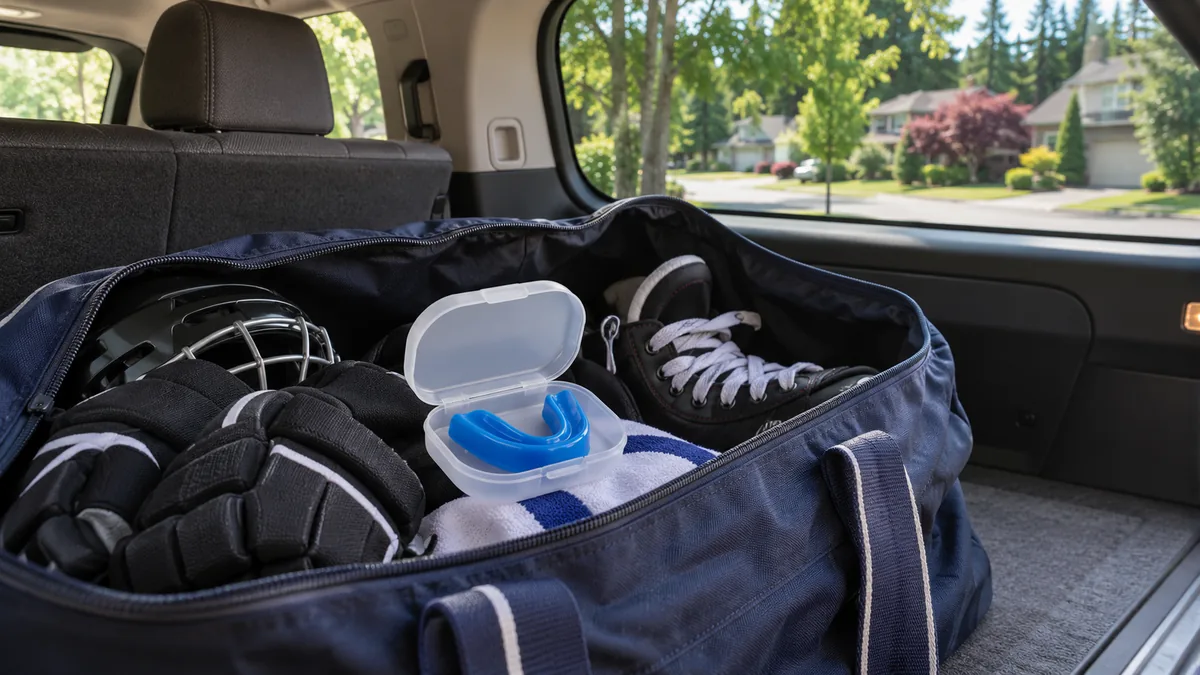
Fraser Heights Recreation Centre and the surrounding fields and gyms carry most local activity, and hockey and soccer are where orthodontic emergencies come from. An orthodontic mouthguard, which sits over the brackets rather than moulding onto them, lives in the sports bag from bond day onward. A standard boil-and-bite guard is the common mistake: it sets to one tooth position, stops fitting as teeth move, and can pull brackets off when it is removed. Sports and mouthguards has the comparison and the after-a-hit decision guide, which is the part worth reading before the season rather than during it.
For wind and brass players, the adjustment after bonding is two to four weeks and is worth timing around concerts and auditions: see playing instruments with braces.
When something breaks
The trip is short enough that a repair is a lunch-hour errand for a parent working locally, or a short detour for everyone else. Do not leave a loose bracket to the next scheduled adjustment; the tooth stops moving and the neighbours drift. Wax covers a sharp edge in the meantime, and the pharmacies along 104 Avenue and at Guildford Town Centre stock it.
| Situation | Action | Timing |
|---|---|---|
| Wire poking at the back | Wax it, or press it flat with a pencil eraser | Book a trim in the next few days |
| Bracket loose or off | Leave it on the wire, wax anything sharp, soft food on that side | Repair this week; ask what is available |
| Aligner lost | Put in the previous tray now | Call the same day |
| Retainer lost or broken | Wear the next one in the set if you have one | Call within days, not weeks |
| Tooth knocked out or displaced in sport | Dental or medical emergency, not an orthodontic one; keep the tooth in milk | Within the hour |
The full version, including what is normal soreness and what is not, is in soreness from braces and appliances.
Choosing a provider
This page is about the logistics of treatment once it is under way. Deciding who should do it, and how to evaluate a plan and a quote, is covered on SurreyOrthodontist.com.
Where Surrey families get this treatment
Guildford Orthodontic Centre
A specialist orthodontic practice in Guildford where Dr. Aly Kanani and Dr. Aida Mesbahi, both Certified Specialists in Orthodontics, provide braces, Invisalign and growth-appliance treatment for children, teens and adults.
The complimentary first visit includes an examination, photographs and a digital scan, with radiographs when indicated, and ends with a written plan and quote. Braces adjustments, aligner checks, emergency visits and retainer follow-up all happen at the same Guildford office.
- Address
- Suite 200 – 10203 152A Street, Surrey, BC V3R 4H6 (Guildford)
- Hours
- Monday to Saturday, 8 am to 5 pm
- Website
- guildfordorthodontics.com
Disclosure: SurreyBraces.com is a treatment guide published by the myORTHODONTIST network, which operates Guildford Orthodontic Centre. The guidance above applies whoever provides your care. Full disclosure.
About this guide
- Published by
- The myORTHODONTIST network
- Written by
- SurreyBraces.com editorial team
- Clinical reviewer
- Dr. Aly Kanani, Certified Specialist in Orthodontics (profile). Review assigned; sign-off date will be shown here once complete.
- First published
- 20 September 2026